Every Purchase Begins with Uncertainty
Every business transaction starts with the same invisible question.
What if I make the wrong decision?
A customer considering new software asks:
Will this product actually solve my problem?
A company evaluating a consultant wonders:
Can this person deliver what they promise?
An investor meeting a founder asks:
Is this someone I can rely on for the next ten years?
Even buying a $20 book involves uncertainty.
Will it be worth reading?
Will it contain useful ideas?
Will it justify the price?
The greater the uncertainty, the harder every sale becomes.
This is true regardless of industry.
Technology changes.
Markets change.
Customer expectations change.
Uncertainty remains.
The companies that grow most efficiently are often not those with the most features.
They are those that remove uncertainty fastest.
That is the economic function of trust.
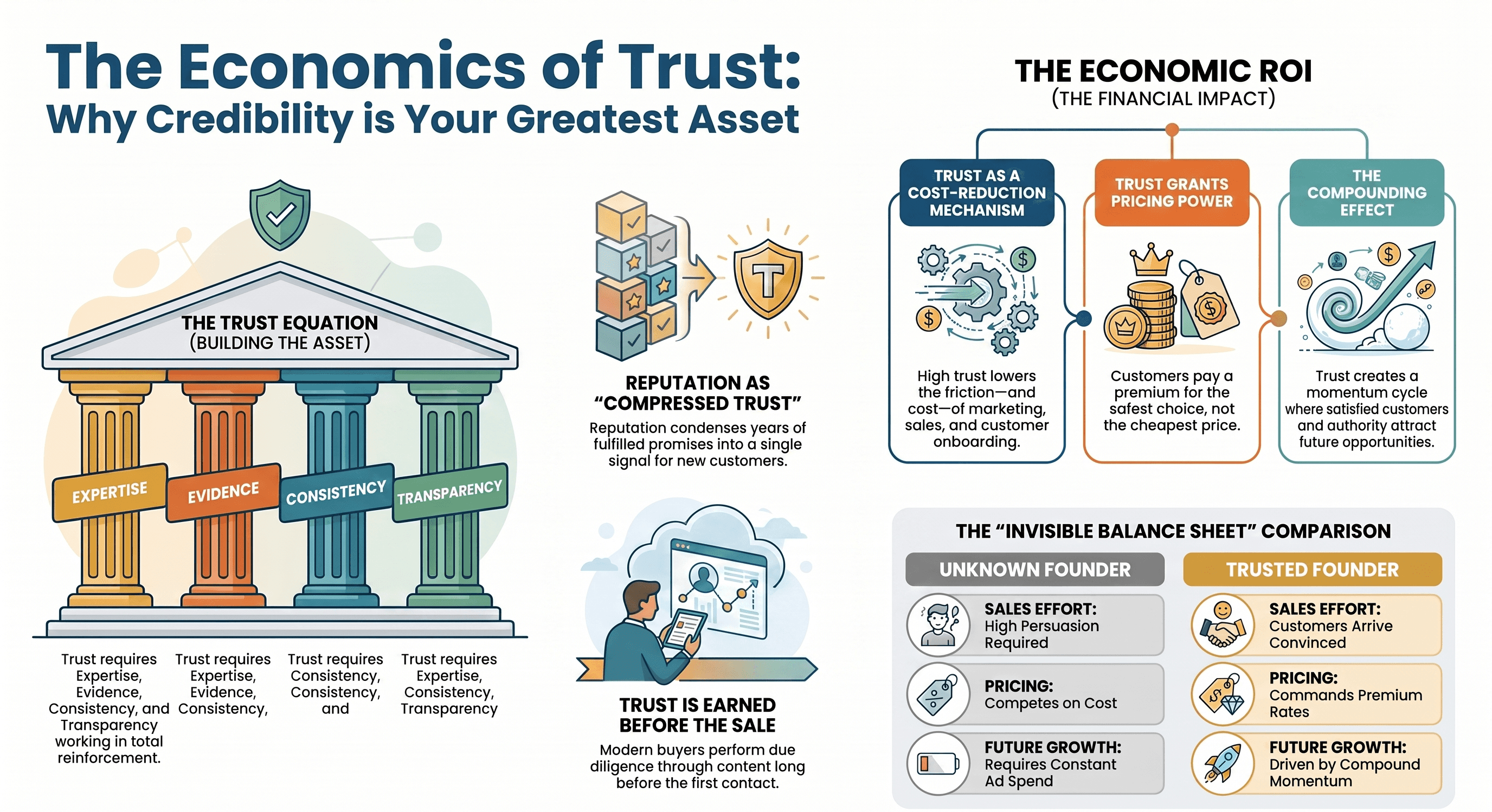
Trust Is a Cost-Reduction Mechanism
Entrepreneurs often think about trust emotionally.
Customers trust a founder.
Employees trust a leader.
Communities trust a brand.
All of these are true.
But they overlook something more important.
Trust changes economics.
Every business faces friction.
Marketing creates friction.
Sales creates friction.
Negotiation creates friction.
Decision-making creates friction.
Customer onboarding creates friction.
Support creates friction.
Trust lowers all of them.
Imagine two software companies selling nearly identical products.
The first is unknown.
The second has spent years publishing thoughtful articles, speaking at conferences, sharing customer stories, and openly discussing product development.
Both launch a new product on the same day.
Which company requires less persuasion?
Which converts visitors more easily?
Which receives more referrals?
Which commands higher prices?
The answer has little to do with software.
It has everything to do with trust.
Trust lowers the cost of every future transaction.
Trust Is Earned Before the Sale
Traditional marketing assumes trust is built during the buying process.
Modern buyers behave differently.
Before scheduling a sales call, they search.
They read.
They compare.
They watch.
They evaluate.
By the time someone contacts a company, much of the decision has already been made.
Content has replaced the first sales meeting.
A founder's articles reveal how they think.
A podcast interview demonstrates how they communicate.
Case studies show how they solve problems.
Open discussions of failures reveal integrity.
Customers quietly perform due diligence long before they speak with anyone.
The sale rarely begins with the product.
It begins with accumulated evidence.
Trust Is Built Through Consistency, Not Visibility
Visibility attracts attention.
Consistency earns confidence.
Many creators experience brief moments of popularity.
Few become trusted authorities.
The difference is repetition.
One useful article rarely changes a reputation.
One thoughtful video rarely creates lasting credibility.
One successful product does not establish enduring confidence.
Trust emerges when people repeatedly observe the same qualities over time.
Competence.
Honesty.
Reliability.
Generosity.
Clarity.
Good judgment.
Consistency transforms isolated actions into reputation.
Reputation transforms familiarity into trust.
Trust transforms attention into opportunity.
The Trust Equation
Trust is often treated as something mysterious.
In reality, it follows a surprisingly predictable pattern.
For a One-Person Company, trust grows when four elements reinforce one another.
Expertise answers: Do you understand this problem?
Evidence answers: Can you prove it?
Consistency answers: Can I expect the same quality tomorrow?
Transparency answers: Will you tell the truth, even when it is uncomfortable?
If one element is missing, trust weakens.
Claims without evidence become marketing.
Expertise without consistency becomes unreliable.
Transparency without competence creates sympathy, not confidence.
Trust requires all four.
Reputation Is Compressed Trust
Imagine meeting someone for the first time.
You know nothing about them.
Trust is low.
Now imagine learning that they have:
Published a respected book.
Helped thousands of customers.
Spoken at leading industry events.
Been recommended by people you already trust.
Without meeting them, your confidence increases.
Why?
Because reputation compresses years of trust into a single signal.
Reputation allows strangers to borrow confidence from previous relationships.
This explains why reputation is one of the highest-return investments a founder can make.
Every fulfilled promise strengthens it.
Every broken promise weakens it.
Unlike advertising, reputation cannot be purchased.
It must be accumulated.
Trust Creates Pricing Power
Many founders compete on price because they lack trust.
Customers compare unknown businesses primarily by cost.
When trust increases, comparison changes.
People begin asking different questions.
Who understands my problem best?
Who has solved this before?
Who will still be supporting this product in three years?
Who shares my values?
Price becomes only one factor.
Trust allows founders to charge more because customers perceive lower risk.
They are buying confidence, not merely functionality.
The world's strongest brands rarely compete by being the cheapest.
They compete by being the safest choice.
For a One-Person Company, trust performs the same function.
Trust Compounds Faster Than Marketing
Advertising produces immediate visibility.
Trust produces long-term momentum.
Every satisfied customer tells another.
Every thoughtful article reaches a new reader.
Every successful product creates another testimonial.
Every public lesson becomes another reason to believe.
Eventually something remarkable happens.
Growth begins generating growth.
Opportunities attract more opportunities.
Customers arrive already convinced.
Partners initiate conversations.
Media requests become more frequent.
Speaking invitations appear without outreach.
Momentum is no longer purchased.
It is earned.
This is why trust behaves like compound interest.
Small, consistent investments produce disproportionately large returns over time.
The Trust Economy
Industrial companies accumulated machinery.
Technology companies accumulated software.
One-Person Companies accumulate trust.
Trust attracts audiences.
Audiences reduce marketing costs.
Lower marketing costs improve profitability.
Higher profitability funds better products.
Better products strengthen trust.
The cycle repeats.
This is not branding.
It is economics.
Trust is one of the few assets that simultaneously reduces costs, increases revenue, shortens sales cycles, improves customer retention, and strengthens competitive positioning.
Very few business investments influence so many outcomes at once.
The Invisible Balance Sheet
Traditional accounting records cash, inventory, equipment, and property.
It does not record trust.
Yet imagine two founders with identical revenue.
One is largely unknown.
The other is widely respected within their industry.
If both launch a new product tomorrow, their financial statements appear identical.
Their future earning potential does not.
One possesses an invisible asset.
Years of accumulated credibility.
Years of fulfilled promises.
Years of public thinking.
Years of helping others.
That invisible balance sheet often determines which company grows faster over the next decade.
The founders who understand this stop asking,
How can I get more attention?
They begin asking,
How can I become more trustworthy?
Because attention may create a sale.
Trust creates a business that lasts.