The One-Person Company Playbook
A structured guide to building a modern one-person company with leverage, trust, digital assets, and scalable knowledge in the AI era.
Start Here
Read the Blueprint Before the Chapters
If you want the shortest path into the Playbook, start with the one-page Blueprint. It compresses the full book into one framework, one flywheel, and five principles.
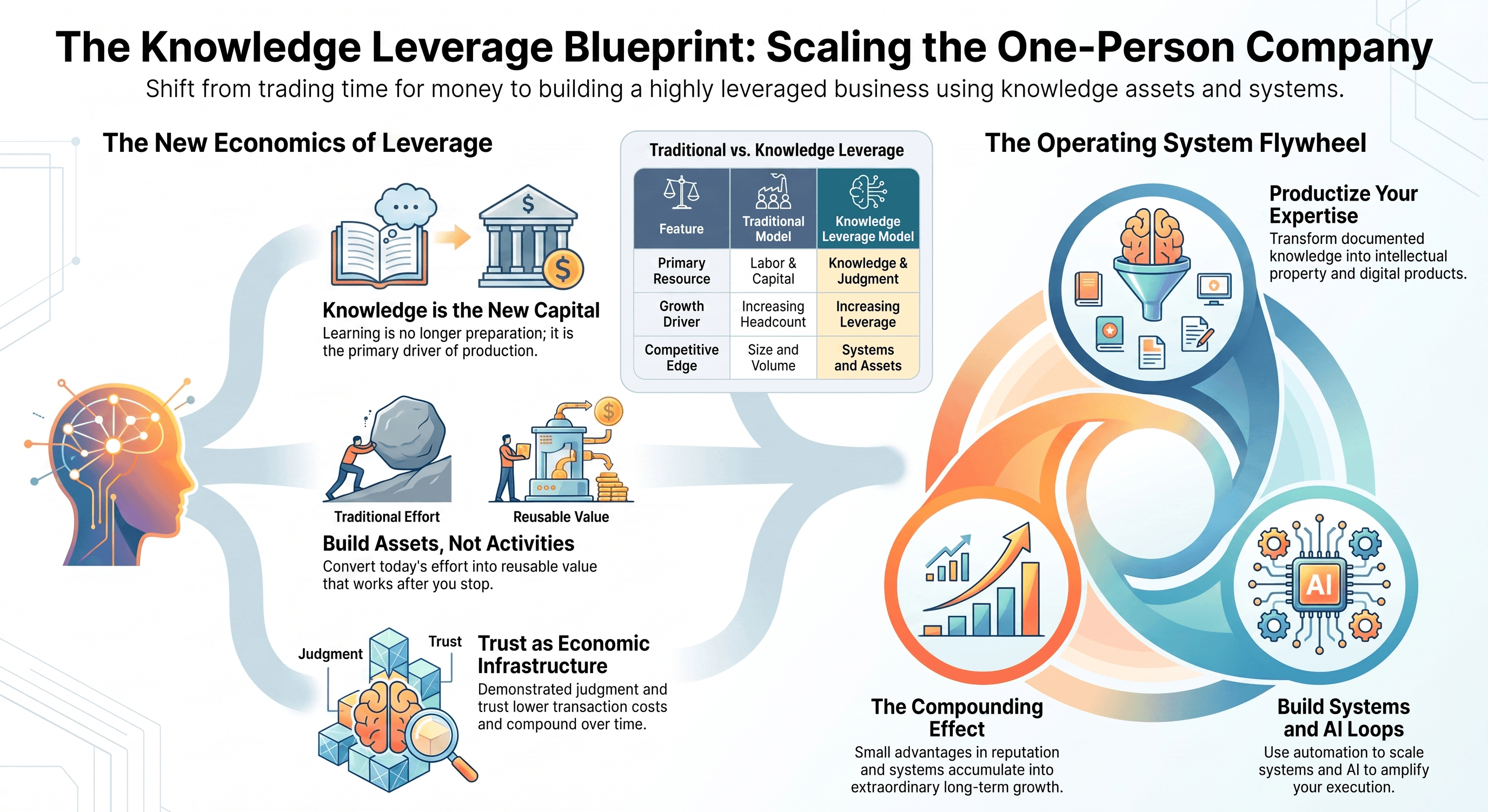
The Knowledge Leverage Blueprint
A one-page guide to the full Playbook, summarizing chapters 1-15 into one framework for knowledge, trust, products, systems, and freedom.
Visual Overview
See the Playbook on a single page
This visual summary gives you the full structure of the One-Person Company Playbook before you move into the parts and chapters below.
Reading Path
Move through the Playbook in three stages
The structure is now clearer: first understand the economic shift, then build the operating system, then zoom out to the future.
Understanding the New Economy
The opening section explains why entrepreneurship is changing, why knowledge became the new capital, and why trust and leverage now matter more than size.
Building the Operating System
This section turns theory into structure: how to build knowledge assets, audience assets, products, systems, and long-term compounding.
The Future
The closing section looks forward: what AI changes, what remains irreplaceable, and why leverage, judgment, and ownership define the future.
Part I
Understanding the New Economy
The opening section explains why entrepreneurship is changing, why knowledge became the new capital, and why trust and leverage now matter more than size.
A New Definition of Entrepreneurship
Why entrepreneurship in the AI era is no longer about building larger organizations, but about turning knowledge into leverage and scalable value.
The Age of Knowledge Leverage
How knowledge becomes the dominant form of leverage in the AI era, why small teams keep winning, and how the Knowledge Flywheel compounds value.
The Asset Theory of One-Person Companies
Why One-Person Companies should be built as asset machines, how the four asset types work together, and how the Asset Ladder creates freedom.
The Economics of Trust
Why trust is an economic asset, how it reduces uncertainty, and why it creates pricing power, momentum, and long-term durability.
Knowledge Becomes Trust
Why audiences trust demonstrated judgment, how the Judgment Loop works, and why original frameworks outlast ordinary content.
The Economics of One
Why One-Person Companies emerge from falling transaction costs, how coordination tax grows, and why modern efficiency favors leverage over size.
Part II
Building the Operating System
This section turns theory into structure: how to build knowledge assets, audience assets, products, systems, and long-term compounding.
The One-Person Company Operating System
How One-Person Companies replace departments with systems and turn mission, knowledge, trust, and assets into a unified operating model.
Building Knowledge Assets
How to turn ideas into durable assets through capture, organization, frameworks, evergreen publishing, and intellectual property.
Audience as an Asset
Why a trusted audience is owned distribution, future demand, and one of the most valuable long-term assets a founder can build.
Products as Knowledge Multipliers
How products multiply knowledge, scale judgment, preserve expertise, and become a founder's digital workforce.
Systems Scale What People Cannot
Why systems turn recurring work into infrastructure, protect attention, and create the operating freedom a One-Person Company needs.
The Power of Compounding
Why One-Person Companies grow through accumulated assets, interacting flywheels, patience, and long-term compounding rather than linear effort.
Part III
The Future
The closing section looks forward: what AI changes, what remains irreplaceable, and why leverage, judgment, and ownership define the future.
AI Is Not Your Competitive Advantage
Why AI makes intelligence cheaper while judgment, mission, trust, and original thinking become more valuable.
Proof
Case studies showing how real founders turn knowledge into assets, trust, products, systems, and compounding leverage.
The Future of Entrepreneurship
Why the AI era rewards leverage, ownership, knowledge capital, freedom, and the long-term rise of the One-Person Company.