The End of an Assumption
For more than a century, entrepreneurship has been defined by a simple assumption:
A successful business grows by becoming larger.
More employees.
More offices.
More managers.
More departments.
More complexity.
Business schools teach it.
Investors reward it.
The media celebrates it.
Growth has traditionally been measured by headcount, market share, and organizational size.
The underlying belief is rarely questioned:
If a company wants to create more value, it must employ more people.
For most of modern history, this assumption was correct.
Large organizations possessed advantages that individuals simply could not match.
They owned factories.
They controlled distribution.
They employed specialists.
They had access to capital.
They benefited from economies of scale.
The larger the company became, the more efficiently it could produce, market, and distribute products.
Size created competitive advantage.
Consequently, entrepreneurship became a process of building organizations.
The founder's job was to recruit talent, coordinate teams, secure investment, and expand operations.
Success meant building a larger company.
But every business model is built upon the technologies available at its time.
When technology changes, the assumptions behind business must also change.
Today, they are changing faster than ever.
Every Technological Revolution Changes the Shape of Business
History is not simply a sequence of inventions.
It is a sequence of changing economic possibilities.
The steam engine transformed physical labor.
Electricity transformed manufacturing.
The internet transformed communication.
Cloud computing transformed software.
Artificial intelligence is transforming knowledge work.
Each revolution follows a similar pattern.
Technology allows fewer people to accomplish more work.
Farmers once required dozens of workers to cultivate large fields.
Mechanization dramatically reduced that requirement.
Factories once employed thousands to manufacture products.
Automation reduced manual labor.
Publishing once required printing presses, warehouses, and nationwide distribution networks.
Today, a single creator can publish to millions with nothing more than a laptop and an internet connection.
Knowledge work is now undergoing the same transformation.
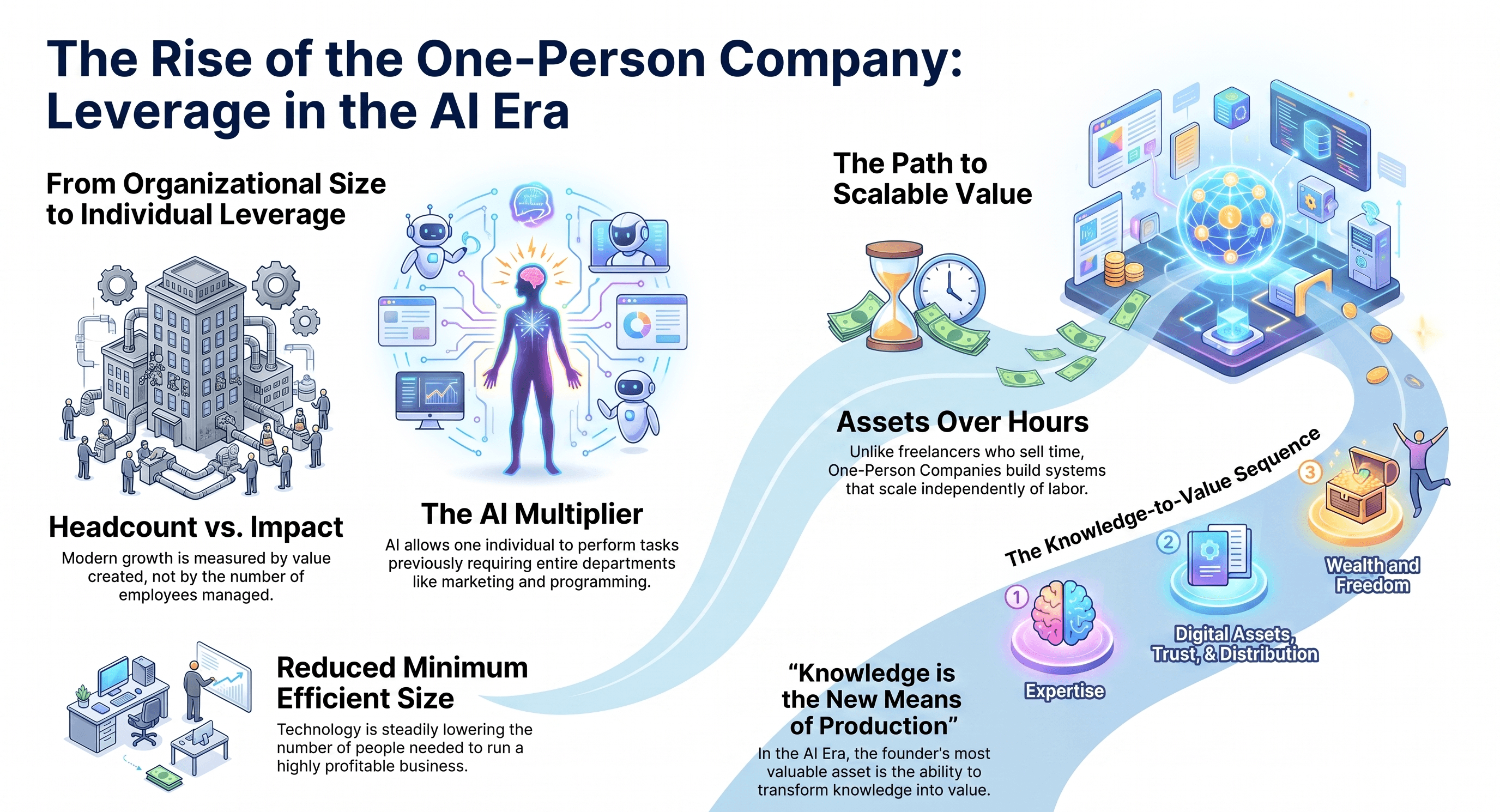
Tasks that previously required entire departments can increasingly be performed by one individual supported by intelligent software.
Writing.
Programming.
Research.
Marketing.
Design.
Customer support.
Translation.
Data analysis.
These activities are no longer constrained by organizational size in the way they once were.
Technology is steadily reducing the minimum efficient size of a company.
This is one of the defining economic shifts of the twenty-first century.
Entrepreneurship Is No Longer About Building Organizations
For generations, entrepreneurs have been taught to answer one question:
"How do I build a bigger company?"
The better question today is different.
"How do I create more value with fewer resources?"
Notice the shift.
The objective is no longer organizational expansion.
It is leverage.
Leverage allows one person's effort to reach thousands or even millions of people.
Software is leverage.
Media is leverage.
Artificial intelligence is leverage.
Automation is leverage.
Digital products are leverage.
Intellectual property is leverage.
Knowledge itself has become leverage.
This changes the founder's role completely.
Instead of managing increasing complexity, the founder learns to design systems that multiply the value of their ideas.
Growth no longer depends primarily on hiring.
It depends on multiplying impact.
The Emergence of the One-Person Company
The term "One-Person Company" is often misunderstood.
Many assume it simply refers to a freelancer working alone.
That definition is too narrow.
A freelancer sells time.
A One-Person Company builds assets.
A freelancer performs work repeatedly.
A One-Person Company creates systems that continue producing value after the original work has been completed.
The distinction is profound.
A consultant who spends every hour serving clients remains limited by time.
A founder who transforms expertise into software, courses, books, templates, media, or digital products creates assets that scale independently of hours worked.
Both may begin with the same knowledge.
Only one converts that knowledge into leverage.
The number of employees is therefore an incomplete way to describe a modern business.
A company employing one person may generate more value than another employing one thousand.
The difference lies not in labor, but in leverage.
Knowledge Has Become the Primary Means of Production
During the Industrial Age, machines were the primary means of production.
In the Information Age, software assumed that role.
In the AI Era, knowledge becomes the defining productive resource.
Knowledge creates software.
Knowledge designs products.
Knowledge builds audiences.
Knowledge solves problems.
Knowledge guides artificial intelligence.
Knowledge creates trust.
Without knowledge, AI produces average results.
Without knowledge, content becomes noise.
Without knowledge, automation merely accelerates inefficiency.
The founder of a One-Person Company therefore manages a fundamentally different resource than entrepreneurs of previous generations.
The most valuable asset is no longer physical infrastructure.
It is the founder's ability to transform knowledge into scalable value.
This observation forms the central idea of this book.
The Knowledge-to-Value Principle
Throughout this book, we will return to one foundational principle.
A One-Person Company exists to systematically transform knowledge into scalable value.
Everything else is built upon this idea.
Experience creates knowledge.
Knowledge generates insights.
Insights become assets.
Assets create trust.
Trust builds audiences.
Audiences enable distribution.
Distribution supports products.
Products generate wealth.
Wealth creates freedom.
This sequence represents a different model of entrepreneurship.
It does not reject growth.
It redefines it.
Growth is no longer measured by how many people work inside the company.
It is measured by how much value one person's knowledge can create.
This is the defining economic opportunity of the AI Era.
And it is the reason why the One-Person Company is not merely another way to organize work.
It is an entirely new way to think about business.