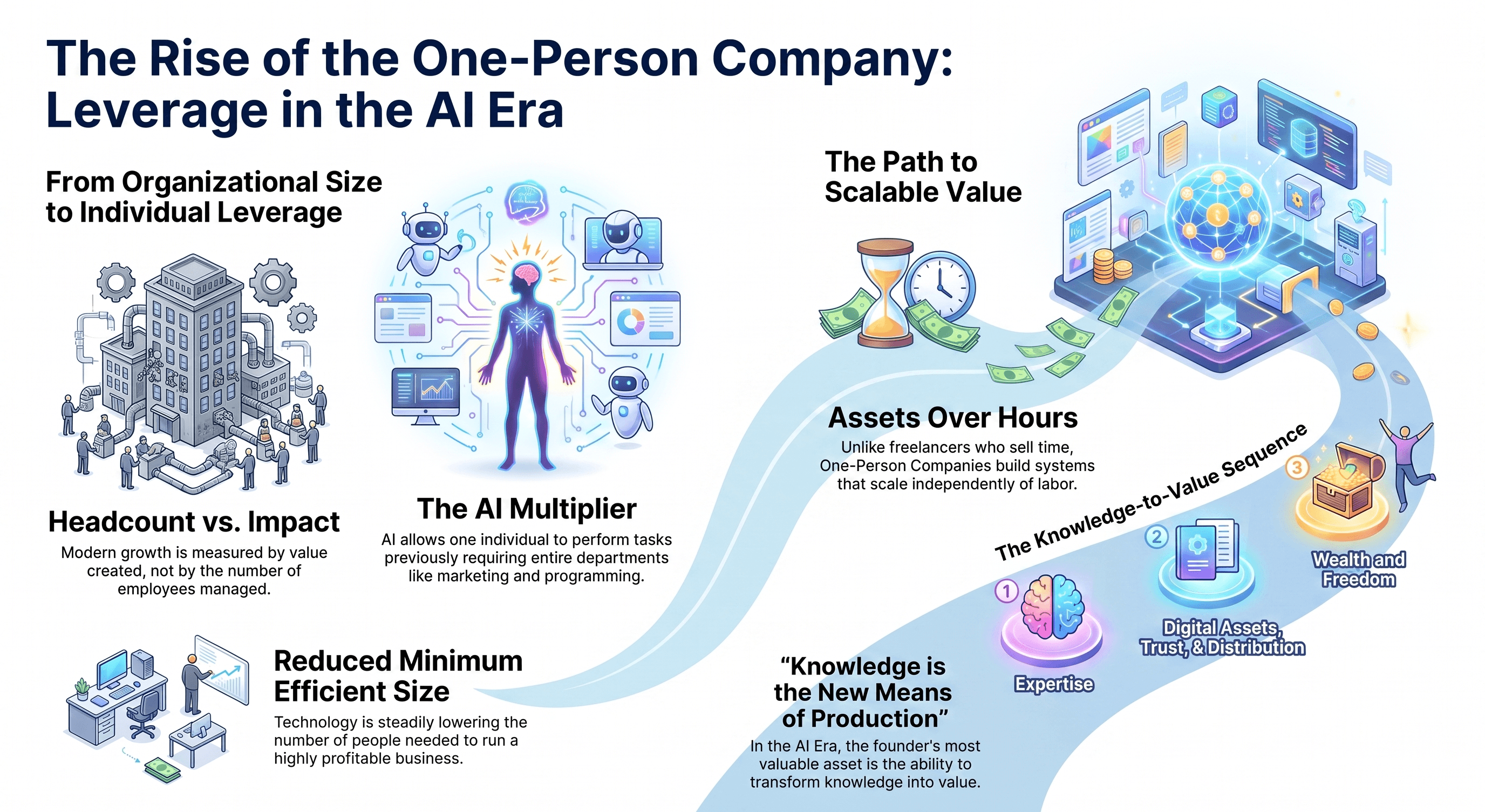
Every Economy Is Built on a Different Source of Leverage
History can be understood as a sequence of leverage.
Each era rewards those who know how to use the dominant form of leverage more effectively than everyone else.
In agricultural societies, land was leverage.
Those who controlled fertile land produced more food, accumulated more wealth, and supported larger communities.
During the Industrial Revolution, machines became leverage.
Steam engines, electricity, and assembly lines allowed factories to produce more with fewer workers.
The Information Age introduced another form of leverage.
Software.
For the first time, one engineer could build something that millions of people could use simultaneously.
Software separated value creation from physical production.
The AI Era introduces a new kind of leverage.
Not physical leverage.
Not computational leverage.
Knowledge leverage.
The ability to transform what one person knows into value that can reach millions.
This distinction is subtle, but it changes everything.
Knowledge Is Different from Information
People often confuse knowledge with information.
They are not the same.
Information is abundant.
Knowledge is organized.
Information answers questions.
Knowledge solves problems.
Information can be copied.
Knowledge is created through experience.
Artificial intelligence can retrieve information almost instantly.
It cannot replace the judgment developed through years of building products, serving customers, making mistakes, and refining ideas.
Two founders may ask the same AI assistant identical questions.
One receives average results.
The other produces extraordinary solutions.
The difference is rarely the prompt.
The difference is the knowledge behind the prompt.
AI amplifies what already exists.
If the underlying thinking is weak, AI accelerates weak thinking.
If the underlying thinking is exceptional, AI accelerates exceptional thinking.
Knowledge determines the quality of leverage.
The Founder Has Become the Factory
In the twentieth century, factories created products.
Today, founders create systems.
This is one of the most important economic transitions of our time.
The modern One-Person Company does not own expensive machinery.
Its production system exists inside the founder's mind.
Ideas become articles.
Articles become audiences.
Audiences become communities.
Communities become products.
Products generate revenue.
Revenue funds new experiments.
New experiments generate better ideas.
The factory is no longer physical.
It is intellectual.
This explains why many of today's fastest-growing businesses appear surprisingly simple from the outside.
There are no warehouses.
No manufacturing plants.
No distribution centers.
Yet immense value is being created.
The founder has become the production system.
Knowledge Compounds Faster Than Labor
Labor scales linearly.
If you work twice as many hours, you can usually produce roughly twice as much work.
Knowledge behaves differently.
A single insight may influence thousands of people.
One framework may shape an entire industry.
One software product may automate millions of repetitive tasks.
One book may continue generating value decades after publication.
Knowledge compounds because it can be reused indefinitely.
Every time it is applied, its cost approaches zero while its value remains.
This is why the most successful One-Person Companies focus on creating reusable knowledge instead of selling reusable time.
Time disappears once spent.
Knowledge continues producing value.
The Knowledge Flywheel
Every successful One-Person Company follows a similar pattern, whether the founder recognizes it or not.
Experience produces knowledge.
Knowledge creates insight.
Insight becomes assets.
Assets attract attention.
Attention builds trust.
Trust creates opportunities.
Opportunities generate new experiences.
The cycle repeats.
We call this The Knowledge Flywheel.
Unlike traditional business models that rely on continually increasing inputs, the Knowledge Flywheel becomes stronger with each cycle.
Every customer teaches something.
Every product reveals new patterns.
Every failure produces new understanding.
Every lesson becomes another asset.
The founder does not merely accumulate revenue.
The founder accumulates knowledge.
And knowledge becomes the source of future revenue.
Why Small Teams Keep Winning
Many of the most influential digital businesses today are built by remarkably small teams.
This is not because they work harder.
It is because they build better leverage.
A small software company can serve millions of customers.
A newsletter written by one founder can influence executives across continents.
A YouTube educator can teach more people in one year than a university professor reaches during an entire career.
Scale increasingly comes from systems rather than staffing.
Hiring is no longer the default solution to growth.
Often, it is the last one.
The first question becomes:
Can knowledge solve this?
If not:
Can software solve this?
If not:
Can automation solve this?
Only then should additional labor become necessary.
This inversion fundamentally changes how companies grow.
Why Knowledge Is the Only Asset That Improves When Shared
Most assets decline as they are used.
Machines wear out.
Buildings require maintenance.
Inventory disappears after it is sold.
Knowledge behaves differently.
Teaching reinforces understanding.
Writing clarifies thinking.
Explaining reveals assumptions.
Publishing attracts feedback.
Each act of sharing often increases the value of the underlying knowledge.
This creates a remarkable economic advantage.
The founder who consistently shares valuable ideas is simultaneously improving the asset while expanding its reach.
Very few assets possess this characteristic.
Knowledge does.
This is why publishing should not be viewed as marketing.
It is a mechanism for refining and expanding intellectual capital.
The Companies That Will Define the Next Decade
The next generation of iconic companies will not necessarily employ the most people.
Nor will they own the largest offices.
They will own the most valuable knowledge systems.
Some will build software.
Others will build media.
Many will build communities.
Some will create educational ecosystems.
Others will combine all of these.
Their common advantage will not be size.
It will be the ability to transform one person's expertise into scalable value.
This is the defining capability of a One-Person Company.
Technology makes it possible.
Knowledge makes it valuable.
Leverage makes it scalable.
Everything else is built upon these three principles.