Most Entrepreneurs Build Income. Few Build Assets.
Ask a new entrepreneur about their goals, and the answers are usually similar.
"I want more clients."
"I want more customers."
"I want more revenue."
These are reasonable ambitions.
But they reveal a common misunderstanding.
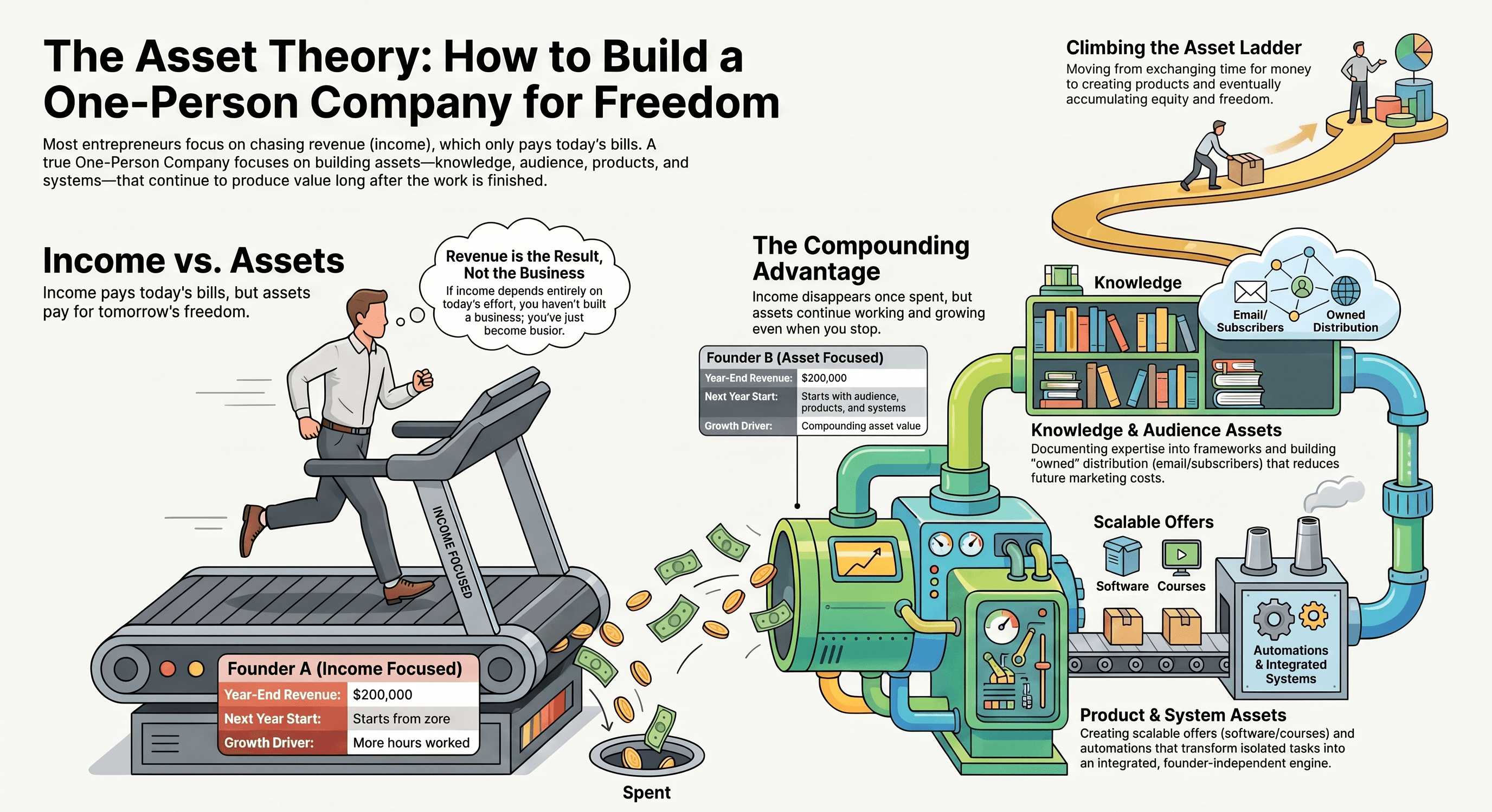
Revenue is not the business.
Revenue is the result of the business.
The real question is:
What produces tomorrow's revenue?
If today's income depends entirely on today's effort, the business has not become more valuable.
It has simply become busier.
Many founders mistake activity for progress.
They work longer hours.
Serve more clients.
Attend more meetings.
Answer more emails.
Revenue grows.
Freedom does not.
The One-Person Company follows a different philosophy.
Instead of asking,
"How can I earn more this month?"
it asks,
"What asset can I build today that will continue creating value long after today's work is finished?"
That single shift changes the economics of entrepreneurship.
Every Business Is an Asset Machine
Every successful company owns assets.
A manufacturing company owns factories.
A logistics company owns transportation networks.
A software company owns code.
A media company owns intellectual property.
An investment firm owns capital.
The visible business is only the surface.
Underneath it lies a collection of assets producing future cash flow.
A One-Person Company is no different.
The difference is simply the type of assets it builds.
Instead of factories, it builds knowledge.
Instead of retail stores, it builds audiences.
Instead of sales departments, it builds trust.
Instead of large organizations, it builds systems.
The founder is not merely creating products.
The founder is assembling an engine that produces value repeatedly.
The Four Assets of a One-Person Company
Original frameworks, books, playbooks, research, tutorials, checklists, templates, databases, decision models, and proprietary methodologies.
Email subscribers, YouTube subscribers, podcast listeners, LinkedIn followers, X followers, private communities, and industry relationships.
Software, digital courses, memberships, books, templates, toolkits, AI applications, licensing, consulting frameworks, and subscription services.
Automation, artificial intelligence, standard operating procedures, onboarding, payment workflows, marketing automation, content pipelines, and support documentation.
Every sustainable One-Person Company accumulates four categories of assets.
Each category strengthens the next.
Together they create a business that becomes more valuable over time.
Assets Compound. Income Does Not.
Imagine two founders.
Both earn $200,000 this year.
Founder A earns every dollar through consulting.
Founder B earns half through consulting and invests the remaining time creating evergreen assets.
At the end of the year, their income is identical.
Their businesses are not.
Founder A begins next year from zero.
Founder B begins with:
A larger audience.
More articles.
Better systems.
Additional products.
Stronger reputation.
More search traffic.
Every asset increases the probability of future opportunities.
Income disappears after it is spent.
Assets continue working.
This is why two founders with identical annual revenue may have dramatically different futures.
The Asset Ladder
One-Person Companies evolve by climbing an Asset Ladder.
Every stage creates more leverage than the one before it.
Most people remain near the bottom.
They exchange time for money.
Professionals move higher by developing specialized skills.
Experts create knowledge.
Educators publish content.
Creators build audiences.
Entrepreneurs launch products.
Founders develop systems.
Owners accumulate equity.
Ultimately, freedom becomes the result.
The ladder is not climbed through luck.
It is climbed through intentional asset creation.
Why the Richest One-Person Companies Look Different
At first glance, successful One-Person Companies appear remarkably different.
One founder builds software.
Another writes books.
Another produces videos.
Another teaches online.
Another licenses intellectual property.
Yet beneath these differences lies the same structure.
Each founder continually converts expertise into assets.
Products differ.
Assets do not.
This explains why successful founders often seem unusually patient.
They are not optimizing for today's income.
They are increasing tomorrow's productive capacity.
Each article.
Each video.
Each framework.
Each product.
Each automation.
Each relationship.
Another asset.
Another brick in the foundation.
Build Assets Before You Need Them
One of the greatest advantages of asset building is optionality.
A founder with an established audience can launch new products faster.
A founder with a respected reputation attracts partnerships more easily.
A founder with documented expertise receives speaking invitations without cold outreach.
A founder with well-designed systems can experiment without overwhelming their schedule.
Assets create options.
Options create resilience.
Resilience creates longevity.
This is why the strongest One-Person Companies often appear calm during periods of uncertainty.
Their business does not depend on a single client, platform, or product.
It rests on a diversified portfolio of assets.
The New Measure of Success
Traditional businesses often measure growth by size.
Headcount.
Office space.
Quarterly revenue.
The One-Person Company measures something different.
Its most important question is:
Is my portfolio of assets stronger today than it was one year ago?
If the answer is yes, the business is becoming more valuable even if revenue has temporarily slowed.
Because assets generate future income.
Income alone does not generate future assets.
That distinction defines the difference between self-employment and a true One-Person Company.
A One-Person Company is not built one client at a time.
It is built one asset at a time.
And over the course of years, those assets become something far more valuable than a paycheck.
They become a business that can continue creating value long after the founder has finished today's work.