• The shift from AI tools to systems that can perform work may create a new operating model for one-person businesses.
For more than a decade, "Artificial Intelligence" - or AI - has been the dominant term for software that can generate content, analyze information, write code, automate tasks and assist with decision-making.
That language may now be entering a new phase.
In September 2026, the U.S. federal government officially began using "Super Intelligence" (SI) in place of "Artificial Intelligence" (AI) in executive-branch communications and other non-statutory materials. The executive order defines SI, for the purposes of the order, using the existing federal definition of artificial intelligence while calling for a future federal definition that reflects the capabilities of newer frontier systems.
The terminology is still far from universally adopted. AI remains the dominant term used by technology companies, researchers, consumers and the broader market.
But the change is worth watching for another reason.
The more important shift may not be the name.
It is the movement from AI as a tool that helps a person work toward intelligent systems that can increasingly perform workflows, make decisions within defined boundaries, use software tools and produce completed work.
For a one-person business, that distinction could be significant.
The question is no longer simply:
> "How can I use AI?"
It increasingly becomes:
> "What work can intelligent systems perform on my behalf?"
And eventually:
> "How much business can one person operate with a digital workforce?"
The Shift: From Artificial Intelligence to Super Intelligence
The term "Super Intelligence" can mean different things depending on context.
In popular discussions, superintelligence has often referred to hypothetical systems whose intellectual capabilities substantially exceed those of humans across a broad range of tasks.
The current U.S. government usage is broader.
The September 2026 executive order uses "Super Intelligence" and "SI" for technologies and systems covered by the existing federal definition of artificial intelligence. It also argues that frontier systems increasingly do more than imitate or automate individual aspects of human intelligence and can amplify human creativity and capability.
That distinction matters.
• SI should not currently be treated as a universally agreed technical category that has replaced AI.
Instead, the emerging terminology can be viewed as a signal of a broader transition:
• AI -> AI agents -> autonomous workflows -> increasingly capable intelligent systems
The technology underneath this transition is developing rapidly.
Modern agents can already use tools, access information, execute multi-step workflows and take actions on behalf of users within defined boundaries. OpenAI, for example, describes agents as systems that independently accomplish tasks using models, tools and guardrails.
That changes the economic question.
A traditional AI application might help a person write an email.
An agentic system may be able to:
- Read the incoming request
- Identify the customer's intent
- Search relevant information
- Make a decision according to defined rules
- Update another system
- Send a response
- Escalate an exception to a human
It is delegation.
From AI Tools to AI Workers
The first wave of AI adoption was largely tool-oriented.
People used AI to:
- Write
- Search
- Summarize
- Translate
- Brainstorm
- Generate images
- Analyze data
- Write code
- Create presentations
The user asked.
The AI responded.
The user then decided what to do next.
The next phase is different.
AI agents are increasingly designed to execute multi-step workflows rather than simply produce an answer. OpenAI's current agent guidance, for example, describes agents as systems capable of managing workflow execution, selecting tools and taking actions while operating within defined guardrails.
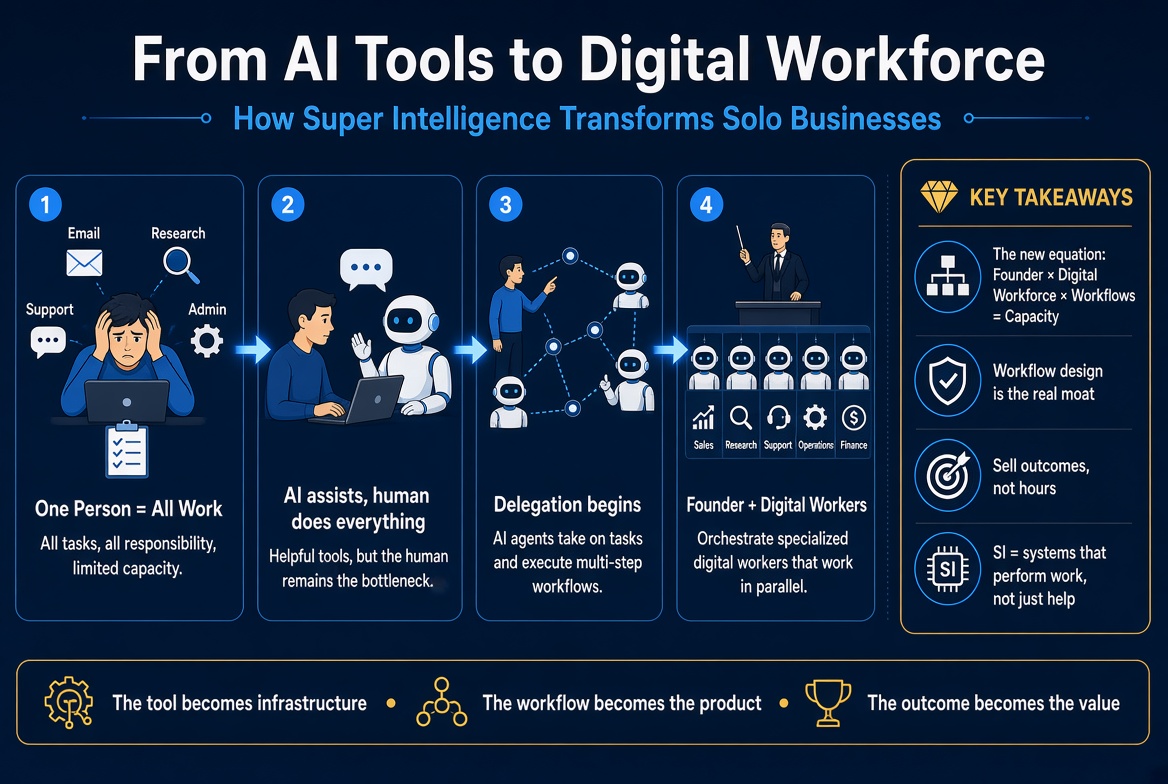
This creates a useful conceptual progression:
AI as a Tool
• Human -> AI -> Output
The human performs the work and uses AI to accelerate it.
AI as an Agent
• Human -> Agent -> Workflow -> Output
The human delegates a defined task to the system.
AI as a Digital Worker
• Human -> Digital Workforce -> Business Process -> Outcome
The human defines the objective, constraints and approval points while intelligent systems perform much of the operational work.
This is where the SI discussion becomes particularly interesting for solo entrepreneurs.
Why This Matters More to One-Person Businesses
A large company can increase capacity by hiring more people.
A traditional one-person business cannot.
There is a hard constraint:
• One person has only so many hours in a day.
That limitation has historically shaped the economics of freelancing, consulting and many small service businesses.
If the founder stops working, the business often stops producing.
AI changes this equation.
If software can perform more of the repetitive work, the founder can operate with greater leverage.
But AI tools alone do not necessarily remove the bottleneck.
A person still has to:
- Decide what needs to be done
- Open the right tools
- Provide instructions
- Review outputs
- Move information between systems
- Follow up
- Fix errors
- Repeat the process
That creates a potentially different model:
> The founder becomes the manager of intelligent systems rather than the person performing every individual task.
For an OPC - a One-Person Company - this could be particularly powerful.
The Emerging SI-Powered One-Person Company
Consider a traditional solo business.
A consultant might personally handle:
- Lead research
- Sales outreach
- Customer onboarding
- Research
- Content creation
- Reporting
- Customer support
- Administration
- Invoicing
- Follow-up
Now imagine the same business with a collection of specialized digital workers.
Digital Sales Worker
Finds potential customers, researches their businesses and prepares qualified prospects.
Research Worker
Collects information, compares sources and prepares research briefs.
Content Worker
Turns approved research into drafts for articles, newsletters or social content.
Customer Support Worker
Handles routine questions and escalates exceptions.
Operations Worker
Updates databases, prepares reports and coordinates recurring workflows.
Finance Worker
Processes defined administrative tasks and prepares information for human review.
The founder does not disappear.
Instead, the founder becomes the orchestrator.
The model begins to look like:
• Founder + Digital Workers + Software + Automation
rather than:
• Founder + More Hours
That is potentially one of the most important implications of the SI trend for one-person businesses.
The Real Opportunity Is Not "More AI"
A common mistake is to think that the opportunity is simply to use more AI tools.
It is not.
A solo founder can easily accumulate dozens of AI subscriptions without creating a better business.
The real opportunity is to redesign the business around delegatable work.
Instead of asking:
> "Which AI tool should I buy?"
Ask:
> "Which parts of my business can be delegated to an intelligent system?"
This leads to a different framework.
Step 1: Identify the Workflow
Find a recurring process.
For example:
• Inbound lead -> qualification -> CRM update -> follow-up
Step 2: Define the Decision Rules
Determine:
- What qualifies as a lead?
- What information is required?
- Which leads should be rejected?
- When should a human intervene?
Step 3: Assign the Work to Systems
Connect the relevant AI agent, software, APIs and automation.
Step 4: Define the Human Checkpoints
Not everything should be automated.
High-risk or ambiguous decisions may require human approval.
Step 5: Measure the Outcome
The system should be evaluated according to what it actually accomplishes.
This last step is especially important.
It connects the SI trend directly to another emerging business trend:
• outcome-based business models.
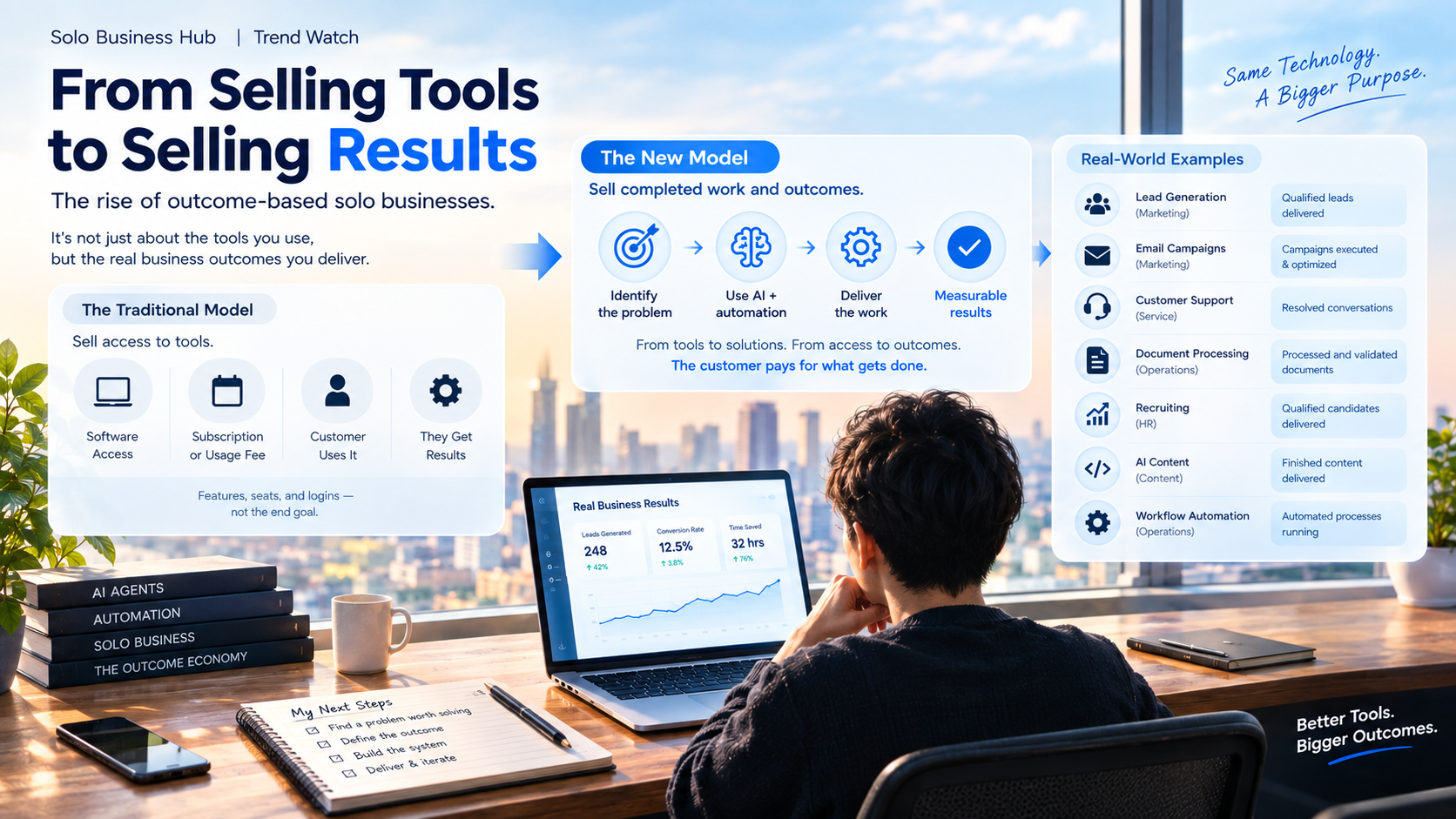
From Selling AI Tools to Selling Outcomes
The economics of software have traditionally been built around access.
Customers buy:
- Seats
- Subscriptions
- Features
- Usage
- API calls
• Pay for completed work.
This is already visible in parts of the AI-agent market.
Intercom, for example, prices its Fin AI Agent around defined outcomes. Its published pricing includes charges for outcomes such as resolutions, procedure handoffs, disqualifications and sales qualifications rather than simply charging for every interaction.
AWS has also published guidance describing outcome-based pricing for agentic AI, where payments can be tied to measurable business results such as successful hires, quality metrics, process improvements or productivity gains.
This creates an important connection:
• AI makes automation easier.
• Agents make delegation easier.
• SI provides a broader narrative around increasingly capable intelligence.
• Outcome-based models change what customers may be willing to pay for.
For a solo founder, these trends can reinforce each other.
The New Solo Business Equation
The traditional solo-business equation looks something like this:
• Time x Skill = Revenue
The more valuable your skill and the more hours you can sell, the more revenue you can generate.
AI introduced a new layer:
• Time x Skill x AI Leverage = Greater Output
But the emerging agentic model suggests another possibility:
• Founder x Digital Workforce x Repeatable Workflow = Business Capacity
This does not mean a one-person company automatically becomes a huge business.
It means the constraint can change.
Instead of asking:
> "How many clients can I personally handle?"
A founder can increasingly ask:
> "How many workflows can my operating system handle?"
That is a very different question.
SI Could Change What "Solo" Means
Historically, "solo" often meant:
• One person doing everything.
The emerging definition could become:
• One person owning the business while intelligent systems perform much of the execution.
That distinction matters.
A company does not necessarily need ten employees to operate ten different functions if some functions can be performed by software and agents.
The organization could remain legally and operationally small while its effective capacity becomes much larger.
This does not eliminate the need for humans.
Instead, it changes where human attention is allocated.
The founder may spend more time on:
- Strategy
- Customer relationships
- Product decisions
- Brand
- Partnerships
- Judgment
- Creative direction
- Exception handling
- Copying information
- Formatting documents
- Routine research
- Repetitive communication
- Data entry
- Basic reporting
- Workflow coordination
The goal is maximum leverage of human judgment.
From Freelancer to Operator
This shift could also change the identity of the solo entrepreneur.
A freelancer primarily sells personal labor.
A consultant primarily sells expertise.
An agency sells coordinated capacity.
An AI-native solo business can potentially sell a managed system that produces a defined result.
Consider the progression:
Freelancer
"I will do this work for you."
AI-Assisted Freelancer
"I will do this work faster using AI."
AI-Powered Service
"I will operate an automated process for you."
Outcome-Based Business
"I will deliver this defined result for you."
The founder may still personally oversee the operation.
But the customer's purchase becomes increasingly detached from the founder's individual working hours.
That creates a path from:
• selling time -> selling expertise -> selling systems -> selling outcomes
For a one-person company, that may be one of the most interesting commercial possibilities created by increasingly capable AI systems.
The SI Opportunity: Build the Operating System, Not Another Tool
This is where the opportunity becomes more concrete.
A solo founder does not necessarily need to build a new foundation model.
They can build businesses around the layer above the models.
Potential opportunities include:
1. Vertical Digital Workers
Build an intelligent worker for a narrow industry.
Examples:
- Real-estate lead qualification
- Dental-office appointment follow-up
- E-commerce customer support
- Recruiting research
- Local-business review management
- Insurance-document processing
2. Managed AI Operations
Instead of selling software, operate the system for the customer.
For example:
> "We manage your inbound lead qualification system."
The customer buys the operation, not the software.
3. Outcome-Based Services
Charge according to a measurable result.
Examples:
- Qualified leads
- Processed documents
- Resolved support cases
- Completed research reports
- Approved applications
- Scheduled appointments
4. AI-to-SI Transition Services
Many businesses will continue using the term AI while gradually adopting more autonomous systems.
That creates demand for:
- Workflow audits
- Agent implementation
- AI workforce design
- Automation architecture
- Agent monitoring
- Evaluation systems
- Human approval systems
It is to help them understand what increasingly capable intelligent systems can actually do.
5. Digital Workforce Management
As businesses deploy multiple agents, another layer becomes necessary:
• Who does what?
A business may eventually need:
- Agent roles
- Permissions
- Workflow definitions
- Approval rules
- Monitoring
- Performance measurement
- Cost controls
- Escalation procedures
The Most Important Skill May Be Workflow Design
The underlying AI model is becoming increasingly accessible.
The difficult part is often not accessing intelligence.
It is knowing how to apply it to a real business process.
Imagine two founders with access to exactly the same AI model.
Founder A asks:
> "Write me a marketing email."
Founder B designs a system that:
- Identifies new leads
- Researches each company
- Classifies the lead
- Selects the appropriate messaging
- Generates a draft
- Checks it against company rules
- Sends it for approval
- Records the result
- Measures response
- Updates the next campaign
They have built a better workflow.
This may become a central competitive advantage in the SI era.
The New Competitive Moat for Solo Founders
If foundation models become increasingly accessible, simply having access to a powerful model is unlikely to remain a durable advantage.
The competitive advantage may instead come from:
• Domain knowledge
Knowing a specific industry's problems.
• Workflow knowledge
Knowing how the work actually gets done.
• Proprietary context
Having valuable customer, process or operational information.
• Distribution
Having a way to reach customers.
• Trust
Being responsible for the outcome.
• Measurement
Knowing whether the system actually works.
• Integration
Connecting intelligence to the customer's existing systems.
In other words:
> The model may be replaceable. The workflow may not be.
That is particularly important for one-person companies because a founder can build deep expertise in a narrow workflow without needing to compete with a large general-purpose software company.
What SI Does Not Mean for Solo Businesses
There is also a danger in interpreting the SI trend too aggressively.
SI does not mean:
- Every business can be fully automated
- Human employees will immediately disappear
- Every AI agent is reliable enough to run unsupervised
- One person can automatically replace an entire organization
- Revenue will automatically increase because AI is involved
- Every business should adopt autonomous agents
AI systems can make mistakes.
Data can be incomplete.
Integrations can fail.
Customers can behave unpredictably.
And some decisions have consequences that justify human review.
Current agent systems are therefore better understood as systems operating within defined workflows, tools and guardrails rather than as completely independent replacements for human organizations.
The practical opportunity is more grounded:
> Use increasingly capable intelligence to make a defined business process more scalable without proportionally increasing headcount.
A Practical Framework for Building an SI-Powered Solo Business
For a solo founder considering this model, the process can be surprisingly simple.
1. Find a Repetitive Business Problem
Look for work that happens frequently and consumes valuable time.
2. Define the Desired Outcome
Do not start with the technology.
Start with:
> "What should be different when this process is finished?"
3. Measure the Outcome
Define exactly what counts as success.
For example:
• Qualified lead
Not:
> "A promising prospect."
But:
> "A prospect meeting the agreed industry, company-size, budget and intent criteria."
4. Break the Process Into Steps
Separate:
- Information gathering
- Decision-making
- Actions
- Human approvals
- Exceptions
5. Assign Each Step to the Right System
Use:
- AI models
- Agents
- APIs
- Automation
- Traditional software
- Human review
6. Create Guardrails
Define:
- What the system can do
- What it cannot do
- When it must ask for approval
- When it must stop
- What information it can access
7. Charge for the Value
If the result can be measured, consider whether the business should charge for:
- Completed work
- Successful outcomes
- Managed operations
- A combination of setup and performance
The Bigger Trend: From AI Assistance to Business Capacity
The most important part of the SI trend may ultimately have little to do with terminology.
Whether the market eventually says:
• AI
• Agentic AI
• Super Intelligence
• SI
or something else, the underlying commercial question remains.
How much useful work can intelligent systems perform?
The answer is changing.
Today's AI can already assist with individual tasks.
Today's agents can increasingly execute multi-step workflows.
The next stage is likely to involve increasingly capable systems that operate across tools, maintain context, make bounded decisions and perform longer-running processes.
OpenAI's current enterprise-agent work, for example, describes agents that can operate across tools, execute recurring workflows and take actions within approved permissions and checkpoints.
That creates a new possibility for the one-person company.
Instead of building a business around one person's capacity, the founder can increasingly build a business around an intelligent operating system.
What One-Person Businesses Should Watch
The SI trend is still early.
For solo entrepreneurs, the most useful signals to watch are not simply whether companies start using the acronym "SI."
Watch for these changes instead:
1. Agents moving from assistants to operators
Can they actually complete workflows?
2. Outcome-based pricing becoming more common
Are customers paying for completed work rather than software access?
3. Digital workers becoming specialized
Are agents being designed around specific jobs and industries?
4. Better agent reliability
Can systems operate for longer periods with fewer human interventions?
5. More business software becoming agent-accessible
Can intelligent systems actually read, write and act across the tools businesses already use?
6. Better measurement
Can companies reliably determine whether an agent performed the job correctly?
These developments matter more to an OPC than the terminology alone.
From One-Person Company to One-Person Organization
The long-term possibility is bigger than simply "using AI."
A one-person business could eventually have a structure that looks something like this:
• Founder
↓
• Business Strategy
↓
• Digital Workforce
- Sales
- Research
- Marketing
- Operations
- Customer Support
- Administration
• Software + APIs + Data
↓
• Measured Business Outcomes
The founder remains the owner and decision-maker.
But the execution layer becomes increasingly software-based.
That could allow a one-person company to operate more like a small organization without becoming a traditional employer-heavy organization.
This is perhaps the most interesting business implication of the emerging SI narrative.
The Bottom Line
The debate over whether the technology should be called AI or SI is still unfolding.
For now, AI remains the dominant industry and consumer term, while SI is an emerging label that has gained official U.S. government usage. The September 2026 executive order is significant, but it does not by itself mean that the global technology industry has stopped using "AI."
For one-person businesses, however, the terminology may be less important than the underlying technological shift.
The important transition is:
> From asking AI to help with work -> to delegating work to intelligent systems.
And then:
> From using intelligent tools -> to operating an intelligent business.
That creates a new strategic question for solo founders:
> What would your business look like if you could hire software instead of another employee?
The answer will not be the same for every business.
But the founders who learn to identify valuable workflows, define measurable outcomes, design reliable agent systems and maintain human oversight may be able to build businesses with significantly more operating leverage than the traditional solo model.
The opportunity is not to build a business around the word SI.
It is to build a business around what increasingly capable intelligence can actually accomplish.
• The tool is becoming the infrastructure.
• The workflow is becoming the product.
• The outcome is becoming the value.
• And the one-person company may become an organization powered by a digital workforce.