How AI Agents Are Turning Solo Founders into Small Business Teams
A few years ago, starting a business alone meant accepting a hard trade-off: keep costs low, but do almost everything yourself. Marketing, customer service, content, research, administration, and finance all competed for the same limited hours.
Hiring solved capacity but introduced expense, management overhead, and complexity.
That equation is shifting.
AI is moving beyond writing assistance and one-off generation. A new generation of AI agents can work with business data, connect to applications, complete multi-step tasks, and support recurring processes.
For solo founders, this opens a different possibility: operating with the capabilities of a small team without necessarily employing one.
The emerging model is the One-Person AI Workforce.
It does not mean one person can replace an entire company with autonomous bots. It means a founder can organize AI tools into specialized roles, assign clear responsibilities, and retain control over the decisions that matter.
The key question is no longer only how much time AI saves. It is how much more business one person can reliably operate.
1. From AI Assistant to AI Workforce
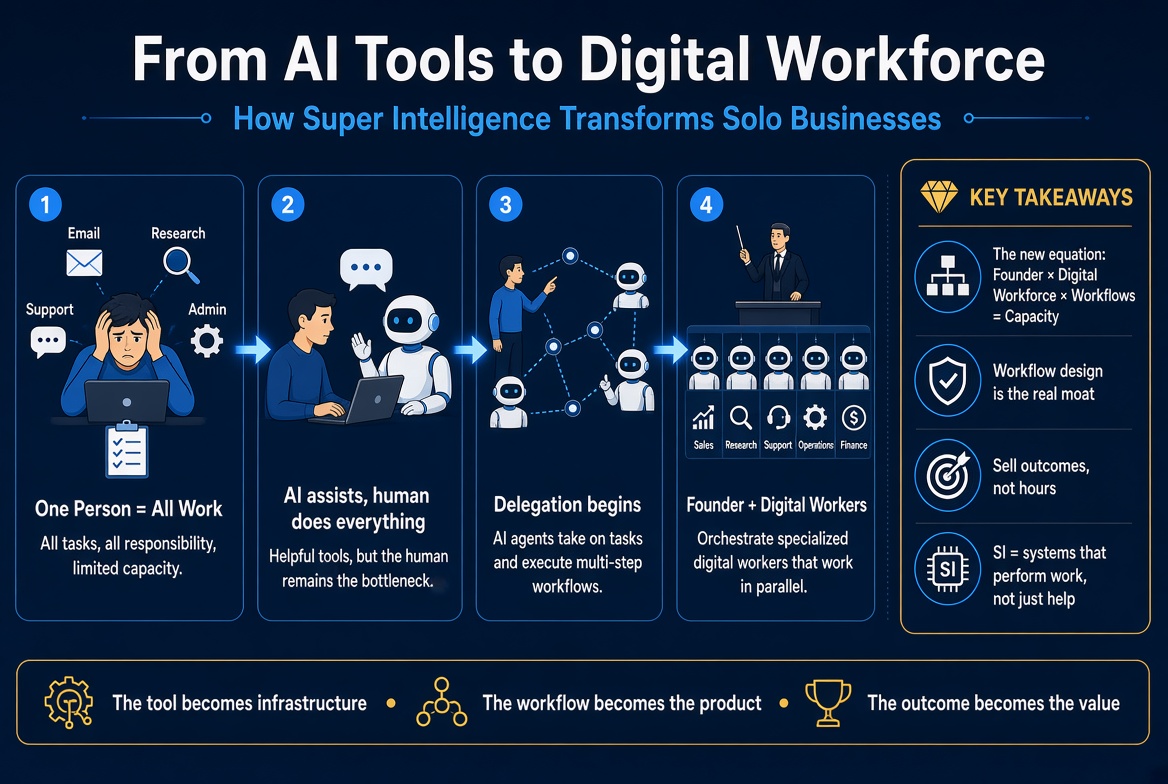
Early mainstream AI tools mainly helped produce individual outputs. You asked a question, received an answer, edited it, and moved on.
An AI agent changes the model.
Instead of asking AI to write an email, a founder can ask it to review incoming inquiries, identify potential customers, draft personalized responses, update a lead tracker, and recommend next steps.
The shift is from isolated assistance to coordinated workflows.
| Traditional AI Assistant | AI Agent |
|---|---|
| Writes a marketing email | Prepares and organizes a campaign |
| Summarizes customer feedback | Categorizes feedback and flags recurring issues |
| Suggests blog topics | Researches topics and prepares content briefs |
| Explains financial data | Analyzes transactions and flags anomalies |
| Answers a question | Completes a defined sequence of tasks |
Google’s October 2026 introduction of the Gemini agent illustrates the direction. The company describes an agent that connects to business applications, uses organizational context, handles knowledge work, creates media, and writes and executes code. For small businesses, Google positions it as a flexible team member that can support roles such as project manager, bookkeeper, inventory manager, or marketing consultant.
This reflects a broader change in business software design: owners increasingly delegate outcomes through a common AI interface instead of mastering dozens of separate applications.
Source: Google Cloud, Empowering SMBs to do more with Gemini, October 8, 2026.
2. Why This Matters: The Solo Business Staffing Problem
The demand for an AI workforce becomes clearer when examining the daily reality of independent owners.
A solo founder might spend Monday on research, Tuesday on content, Wednesday on inquiries, Thursday on the website, and Friday on invoices and administration. The constraint is rarely pure expertise—it is available capacity.
A September 2026 FreshBooks survey of 500 solopreneurs and micro-business owners found:
- 90% said AI makes it easier to start and run a business.
- 60% credited AI with helping them launch something they could not have built alone.
- 86% turn to AI before hiring outside help when facing a task they cannot handle alone.
- 77% are using or actively experimenting with AI agents.
- 56% use AI for marketing and design; 51% use it for customer service.
Adoption is expanding, but the biggest remaining opportunity lies beyond content production—in the less visible work required to keep a business running.
Source: FreshBooks, The Era of the Solopreneur, updated September 15, 2026.
For solo founders, the next stage is building a repeatable operating system rather than collecting more individual tools.
3. What a One-Person AI Workforce Looks Like
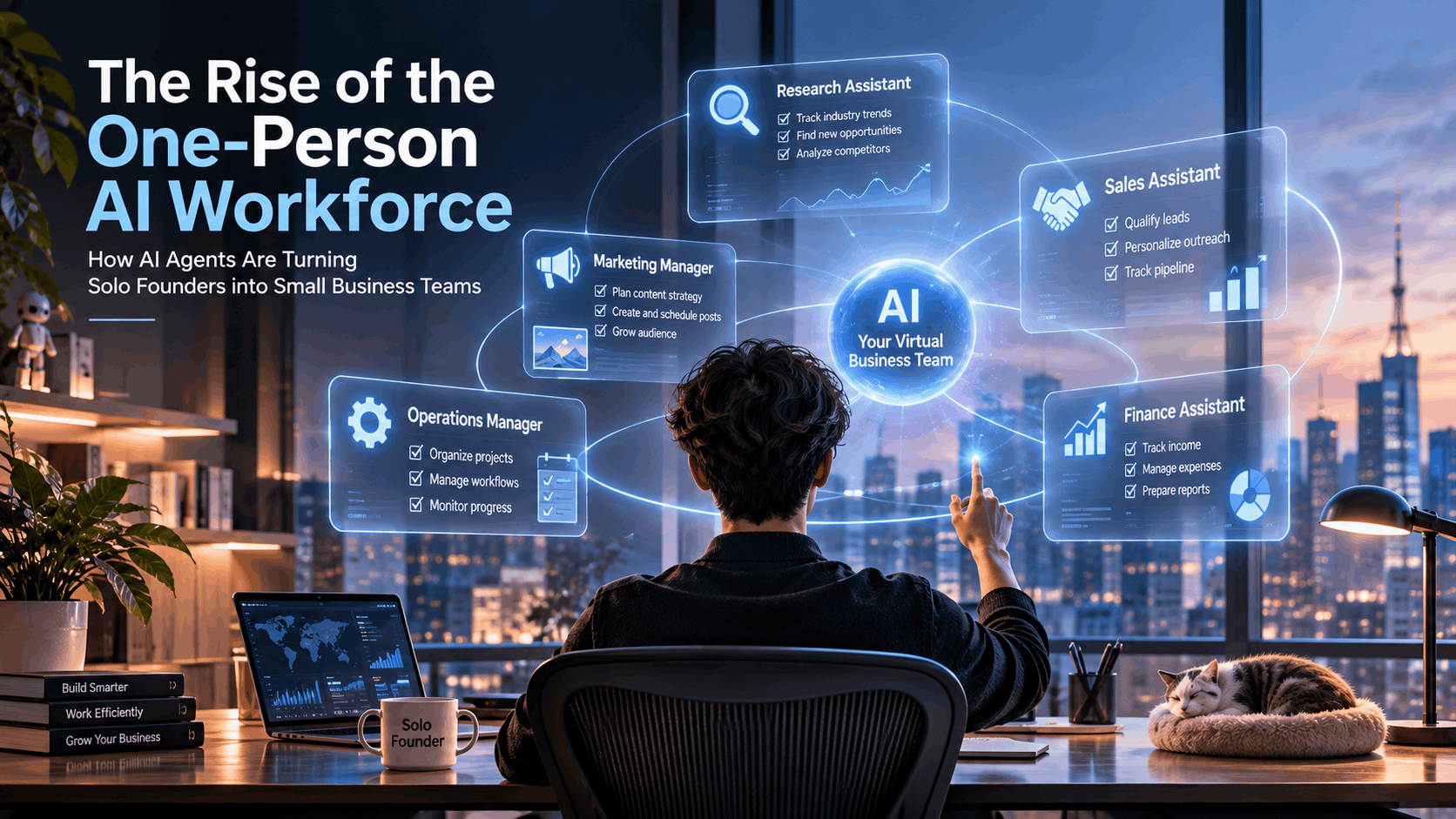
Imagine a solo founder running a small digital business that sells research services, publishes insights, and generates revenue through consulting and digital products. There are no full-time employees. Instead, AI is organized into five functional roles.
Role 1: AI Research Assistant
Responsibility: Market intelligence and opportunity discovery
Every Monday the assistant is tasked to:
- Identify significant product launches and industry developments.
- Monitor relevant companies and competitors.
- Surface new customer questions and emerging search topics.
- Compare developments against existing content.
- Prepare a weekly opportunity report.
• Practical prompt example:
> Act as the market research analyst for a one-person digital business. Identify five developments from the past seven days that could create new opportunities in [industry]. For each: what happened and when, original source, why it matters to the target audience, potential demand, and possible content or product angles. Separate verified facts from interpretation. Do not invent statistics.
The founder reviews and decides what deserves attention. AI handles the initial workload.
Role 2: AI Marketing Manager
Responsibility: Content production and distribution
A practical weekly workflow:
- Monday — Topic research
- Tuesday — Research brief, outline, headlines
- Wednesday — First draft + social posts
- Thursday — Visual assets
- Friday — Adaptation for LinkedIn, newsletter, and other channels
Role 3: AI Sales Assistant
Responsibility: Lead qualification and customer communication
Incoming inquiries are collected, requirements extracted, categorized, missing information flagged, personalized responses drafted, and leads logged. The founder reviews and decides whether to send.
This simple loop makes a one-person business appear more responsive and organized without requiring constant availability.
Role 4: AI Operations Manager
Responsibility: Project coordination and routine administration
A weekly operations check can review outstanding tasks, flag overdue items, summarize progress, organize documents, and produce a prioritized list for the founder’s attention. Information scattered across email, documents, and project tools becomes more usable.
Role 5: AI Finance Assistant
Responsibility: Financial visibility and administrative support
It can prepare monthly summaries of revenue, outstanding invoices, expenses, and unusual changes, then recommend actions. The founder retains final approval on payments, tax matters, and records. AI organizes; the founder decides.
4. Real-World Examples Already Underway
The One-Person AI Workforce is still forming, but its underlying capabilities are already in use.
NEEOH (Brazilian out-of-home advertising platform) uses Gemini Enterprise to standardize AI usage, generate campaign copy, and prepare client proposals while protecting corporate data.
Lesson for solos: Maintain approved libraries of service descriptions, case studies, and pricing so AI can draft proposals that the founder then finalizes.
KLog.co (Chilean logistics technology company) automated cargo tracking and shipping paperwork, cutting manual data-entry errors by more than 90% and increasing document processing capacity tenfold.
Lesson: Repetitive information processing is a high-leverage target even at small scale.
Salt Productions and Pinch Creative (U.S. event production and creative agencies) turned fragmented files into a searchable knowledge base, reducing administrative and presentation bottlenecks.
Lesson: Information fragmentation hurts one-person businesses too. Connecting email, Notion, Drive, and spreadsheets into a queryable workspace recovers meaningful time.
These are documented enterprise applications, not claims that the companies run as one-person AI teams. Source: Google Cloud, October 8, 2026.
5. How to Build Your Own: A Practical 30-Day Plan
The biggest mistake is trying to automate everything at once. Start with one repetitive, low-risk process.
• Week 1 — Identify the first role
List recurring activities and classify them by AI suitability and required human involvement. Choose one process that is repetitive, time-consuming, and relatively low-risk (often weekly research or content preparation).
• Week 2 — Define a clear workflow
Specify input, process steps, expected output, and approval gate. Vague instructions produce vague results.
• Week 3 — Connect the minimum tools
A lean stack might include one strong AI model (Claude, Gemini, or ChatGPT), an automation layer (Zapier, Make, or n8n), and a knowledge base (Notion or Google Drive). Add only what removes a real handoff.
• Week 4 — Measure and expand
Track time saved, output quality, business impact, and how often manual correction is needed. Expand only when a genuine bottleneck has been removed.
6. The Tools Behind the Model
| Tool | Primary role | Solo application |
|---|---|---|
| ChatGPT / Claude / Gemini | Reasoning, research, agent workflows | Core intelligence layer |
| Zapier / Make / n8n | Workflow automation | Connecting apps and triggers |
| Notion AI | Knowledge and documentation | Business memory and project context |
| Canva | Design | Marketing visuals |
| FreshBooks / similar | Finance | Invoicing and expense visibility |
A chatbot alone is not a workforce. The workforce emerges when capabilities are organized around actual business responsibilities.
7. Limitations: An AI Workforce Still Needs a Human Manager
Agents can misunderstand instructions, rely on inaccurate information, or take unintended actions. For a solo business, even small errors can matter.
• Clear boundaries:
- Financial decisions — AI organizes; humans approve payments, taxes, and records.
- Customer communication — AI drafts; humans review sensitive, contractual, or complex matters.
- Public content and brand — AI researches and drafts; humans verify facts and approve publication.
The goal is reliable delegation, not maximum autonomy.
8. The Future of the One-Person Company
Business growth and headcount growth are beginning to decouple. An AI-supported solo consultant, publisher, or digital product business can expand operational capacity through software rather than people.
Human judgment becomes more, not less, important. The competitive advantage will belong to those who know what to delegate, how to structure workflows, how to evaluate results, and where human attention creates the highest value.
The most successful solo founders may not be those who adopt the most tools. They will be those who build the most effective working relationship between human judgment and machine execution.
• A one-person business does not have to remain a one-person operation.
With a well-designed AI workforce, one founder can operate with capabilities once associated with a much larger team.
The real opportunity is not simply doing more work with fewer people. It is building a different kind of business from the start.
Key Takeaways for Solo Founders
- Start with a business problem, not a tool.
- Assign AI agents clear roles and measurable responsibilities.
- Automate repeatable workflows before complex decision-making.
- Connect information carefully and control permissions tightly.
- Keep human approval for financial, legal, customer-sensitive, and public-facing actions.
- Measure business outcomes, not the number of tasks automated.
• The next competitive advantage for a solo founder may not be working harder. It may be learning how to manage an AI workforce.