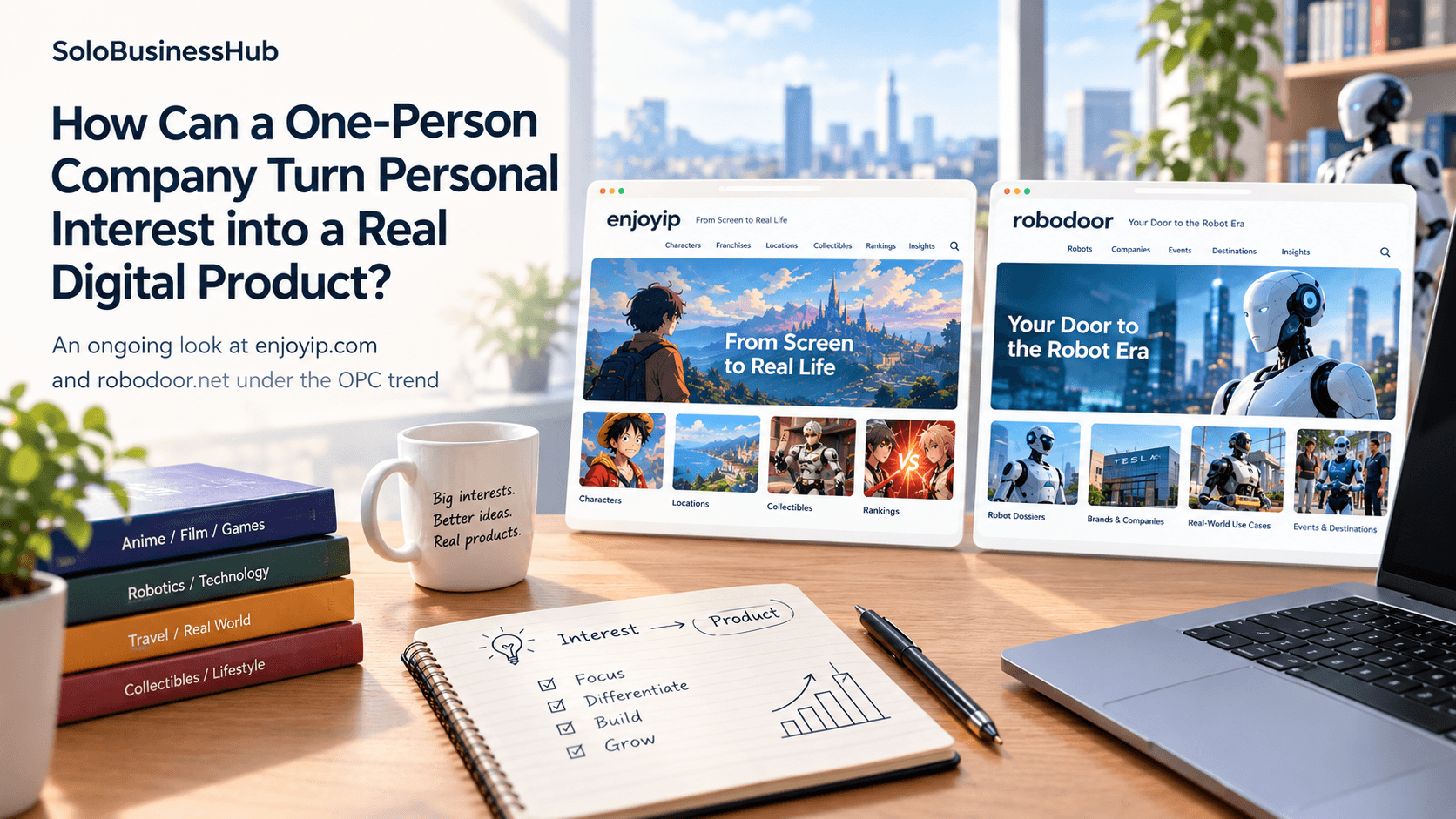
An ongoing look at Enjoyip.com and Robodoor.net under the OPC trend
One-person companies are no longer a niche experiment. They have become one of the clearest entrepreneurial trends of the moment.
Tools are cheaper, AI compresses work that once required a small team, distribution channels are more direct, and audiences increasingly respond to products that carry a distinct point of view. As a result, more people are trying to turn personal interests into websites, tools, or content products.
The reality is harsher than the slogan. Most interest-driven projects end up as yet another content site—enthusiastic, regularly updated, topically relevant, and almost interchangeable.
The real question is never simply “What do you like?”
It is this: Can you organize that interest into an experience that is difficult for others to replicate easily?
Two ongoing experiments approach the question from different angles:
- Enjoyip.com starts with popular culture and examines how fictional worlds extend into real-life experiences—characters, locations, collectibles, and interactive comparisons.
- Robodoor.net starts with robotics and examines how robots move from labs, demos, and science-fiction imagination into everyday life—product dossiers, brands, real-world deployments, and places where people can actually encounter them.
1. The Other Side of the Trend: Interest Is Easy to Start, Hard to Productize
The appeal of the OPC model is low friction. A single founder can launch a site, publish content, and add features quickly. Popular culture and robotics both look especially promising—one carries built-in cultural heat, the other rides the larger narrative of a coming “robot era.”
Low friction, however, also means high sameness.
Launch “an anime and movie site” or “a robotics information platform” and you immediately enter crowded territory. Character profiles, release coverage, product specs, industry news—these materials are produced in volume every day. Why should anyone choose yours?
Most solo projects follow a familiar sequence: produce content first, chase traffic second, think about monetization later. It feels rational in an OPC context. In practice it often traps founders in a cycle of constant output with little accumulated advantage.
Both Enjoyip and Robodoor began with genuine interest. Both were quickly forced to confront a sharper question: if the site only covers the subject, what justifies its existence?
Enjoyip converged on a simple observation. After people finish a film, series, or game, their interest rarely ends. It often extends outward: they want deeper knowledge of a character, comparisons across fictional universes, visits to real locations tied to the story, physical objects that bring a character into the real world, or an understanding of how a fictional design becomes a manufactured product.
Robodoor converged on a parallel observation. Interest in robots rarely stops at specification sheets. People want to watch real demonstrations, compare the actual capabilities and limits of different platforms, understand which companies are moving toward useful deployment, visit places where robots are already operating (theme parks, hotels, museums), and see how far the science-fiction vision of helpful machines has actually progressed.
Both lines of inquiry point to the same product principle: turn the movement from imagination or media into lived reality into something structured and experienceable.
The most common mistake one-person companies make is treating “the field I enjoy” as identical to “my product direction.” The trend rewards those who can compress interest into a clear organizing idea.
2. Define the Product Before Expanding the Content
Speed of decision is an OPC advantage. Scarcity of attention is the corresponding constraint. Without a clear product boundary, content expands endlessly and maintenance costs rise just as fast.
Enjoyip constrains itself with the positioning From Screen to Real Life. It does not attempt to become a general entertainment destination. Instead it organizes around the ways fictional worlds connect to real experiences—character and franchise foundations, interactive comparison tools, real-world locations, and physical collectibles.
Robodoor constrains itself with Your Door to the Robot Era. It is not another robotics news aggregator. It builds a discovery platform: structured robot dossiers that place specifications, history, and real-world use cases side by side; company and brand pages; events and competitions; and curated destinations where robots are already part of the operating environment.
Both projects use a central proposition to filter what gets built. Not every related idea earns a permanent place.
For a solo founder the essential discipline is to ask first whether a feature or content type strengthens the core claim, and only then whether it might attract traffic. Otherwise the site grows larger while becoming steadily less distinctive.
3. Differentiation Lives in Method, Not Merely in Topic
Within the OPC conversation, many people interpret differentiation as “find a narrower niche.” That can help, but it is rarely sufficient. Topics can be copied. Methods are harder to replicate.
Enjoyip works with a reusable set of questions: What does this fictional world prompt people to discover or experience? What happens when an element of fiction becomes a physical object, a real place, or an interactive tool? What is gained, what is lost, and what can be learned from the difference?
Robodoor applies a parallel method: What is this robot or brand actually used for in the real world? How large is the gap between demonstration and useful deployment? When robots move from screens into theme parks, hotels, or workplaces, what do people actually experience? Which capabilities have been delivered, and which remain aspirational?
The same underlying logic—consistently examining the passage from imagination or media into reality—supports very different vertical content without forcing everything into a single template.
For one-person companies this matters more than raw publishing volume. A solo founder cannot out-produce team-backed media. It is still possible to build recognition through a consistent explanatory framework, evaluation standards, information architecture, and interactive experience.
4. Content Must Become an Experienceable Product
Pure content sites are increasingly difficult to defend. Articles are easy to imitate and search results grow more competitive.
A more durable direction is to let content and structured experience reinforce each other.
Enjoyip turns character information into participatory comparison, examines collectibles through the lens of what the physical object actually captures or loses from the original design, and treats location content as a bridge from online discovery to offline action.
Robodoor turns robot information into full dossiers that can be compared, frames “experience” as browsable real-world destinations, and treats events and competitions as trackable benchmarks rather than one-off news items.
In both cases the aim is the same: give visitors reasons to stay, compare, and return rather than read a single page and leave.
The hard constraint remains: every new feature adds development, research, maintenance, and navigation complexity. For a one-person operation, a feature that attracts little use becomes a permanent burden. Before building, three questions are worth repeating: Does it serve the central purpose? Does it deliver something an ordinary article cannot provide as effectively? Is there a low-cost way to test whether people actually use it?
The rational goal is not the largest possible website. It is the smallest coherent product that still delivers a meaningful experience.
5. Building the Product Is Only Half the Work
The OPC trend can create a seductive illusion: if the product is good enough, users will find it. They rarely do.
Search-dependent projects are especially unforgiving. Indexing does not guarantee impressions, impressions do not guarantee clicks, and clicks do not guarantee return visits. Many solo projects stall at the stage of “I have built a great deal and almost no one knows it exists.”
Both Enjoyip and Robodoor treat discoverability as part of the experiment rather than a problem to be solved later. A practical approach separates distinct questions: Is the site technically crawlable and correctly configured? Does the content offer value that is not readily available elsewhere? Are there early signals of interest? Beyond search, are one or two relevant channels being tested at small scale?
A one-person company cannot afford to spread attention across every platform at once. Focused experiments with clear feedback loops outperform diffuse presence. Distribution belongs inside product development from the beginning.
6. Measure Against Hypotheses, Not Against Activity
It is easy for a solo founder to track progress through countable outputs—articles published, pages added, features launched. Those numbers describe activity. They do not confirm that the direction is working.
A more useful frame links activity to explicit hypotheses: whether the core concept attracts interest, whether the content feels distinctive, whether visitors explore further, whether interactive or archival features see repeat use, whether certain content types support outbound actions or revenue, and whether the project remains sustainable relative to time and cost.
Early-stage projects first need evidence that people can find the work and understand what it is offering. Monetization metrics come later. The purpose of measurement is not to prove the original idea correct; it is to reveal which parts deserve further investment.
7. Treat Monetization as a Design Decision
In OPC discussions, monetization is often reduced to “get traffic, then add ads or affiliates.” That reverses the proper order.
Sustainable approaches begin with observed user behavior and then match a model to it. If visitors arrive at product or collectible pages with clear purchase intent, affiliate links may fit. If a tool or dossier is used repeatedly, a premium tier may eventually be testable. If most visits are one-time reference lookups, subscriptions will be difficult to justify.
Both projects still treat revenue models as open questions to be validated. That stance is healthier than forcing a monetization layer onto an unproven product. For a solo founder, trust is an asset that takes time to build and very little time to damage. Commercial relationships should be disclosed, claims supported, and recommendations kept useful even when no commission is involved.
8. Constraints Are the Real Leverage
Large organizations have staff, budgets, and access. One-person companies are disadvantaged on almost every conventional dimension. Those same constraints, however, force sharper choices: depth over unfocused breadth, reusable methods over generic answers, incremental feature testing, careful automation that still preserves judgment, and explicit decisions about what not to build.
Both Enjoyip and Robodoor illustrate the same point. A solo founder’s most limited resource is not time in the abstract; it is the focus of attention. The trend does not reward individuals who try to imitate large media companies. It rewards those who accept limits and convert them into precise positioning.
9. Knowing When to Persist, Adapt, or Stop
Passion helps a founder continue through slow early periods. It can also obscure the fact that a particular strategy is not working.
Low traffic does not automatically mean the idea is wrong—distribution, technical issues, unclear positioning, or timing may be responsible. Neither should low traffic be endlessly explained away as “still early.”
Clearer decisions become possible when evaluation criteria are set in advance. A defined period focused on one content direction, one distribution channel, and one observable behavior produces evidence that can support persistence, adaptation, or deliberate stoppage. One of the genuine advantages of the OPC model is the ability to test at relatively low cost—provided the tests are real and the conclusions are honest.
10. The Real Opportunity Is a Distinctive Way of Connecting
The OPC wave makes it easy to believe that turning any personal interest into a product is enough to ride the trend.
What actually separates outcomes is the quality of the connection a founder creates.
Enjoyip is testing whether the relationship between fictional worlds and real-life experiences can support a digital product that people find both useful and distinctive.
Robodoor is testing whether the path from science-fiction imagery and laboratory demos to consumer robots and accessible real-world experiences can support an equally structured discovery platform.
The subjects differ; the method is aligned. Both attempt to turn the movement from screen or imagination into reality into something that can be browsed, compared, and acted upon.
For other one-person companies the opportunity may lie in linking a hobby to a practical tool, turning specialized knowledge into a navigable resource, or building a small interactive product around a recurring problem. The specific topic matters less than the strength of the link between the founder’s knowledge, the user’s actual interests, and the experience being offered.
In the end the challenge is not to publish everything there is to know about a passion.
It is to decide what that passion uniquely enables you to create—something that would be difficult to find, understand, or experience in quite the same way elsewhere.
That is the point at which personal interest begins to take the shape of a digital product.
And that is the practical dividing line, inside the OPC trend, between projects that remain content sites and those that have a chance to become something more durable.
A Note on These Cases
Enjoyip.com and Robodoor.net are ongoing independent projects. The first explores the connection between fictional worlds and real-life experiences; the second explores the path from robotic imagination and demonstration to everyday discovery and real-world encounters. Both represent attempts by one-person companies to turn personal interest into distinctive digital products. Audience growth and business models remain to be validated. This article uses them as working examples of product decisions, not as proven commercial successes.
Disclosure: Both sites are operated by the founders discussed in this case study.
Explore the projects
Enjoyip.com — From Screen to Real Life
Robodoor.net — Your Door to the Robot Era