For years, the internet business playbook was relatively simple:
Build a tool.
Charge a subscription.
Acquire users.
Add features.
Grow the customer base.
That model is still alive. But the rise of AI agents is creating a different commercial logic—one in which customers increasingly care less about which tool they use and more about what gets done.
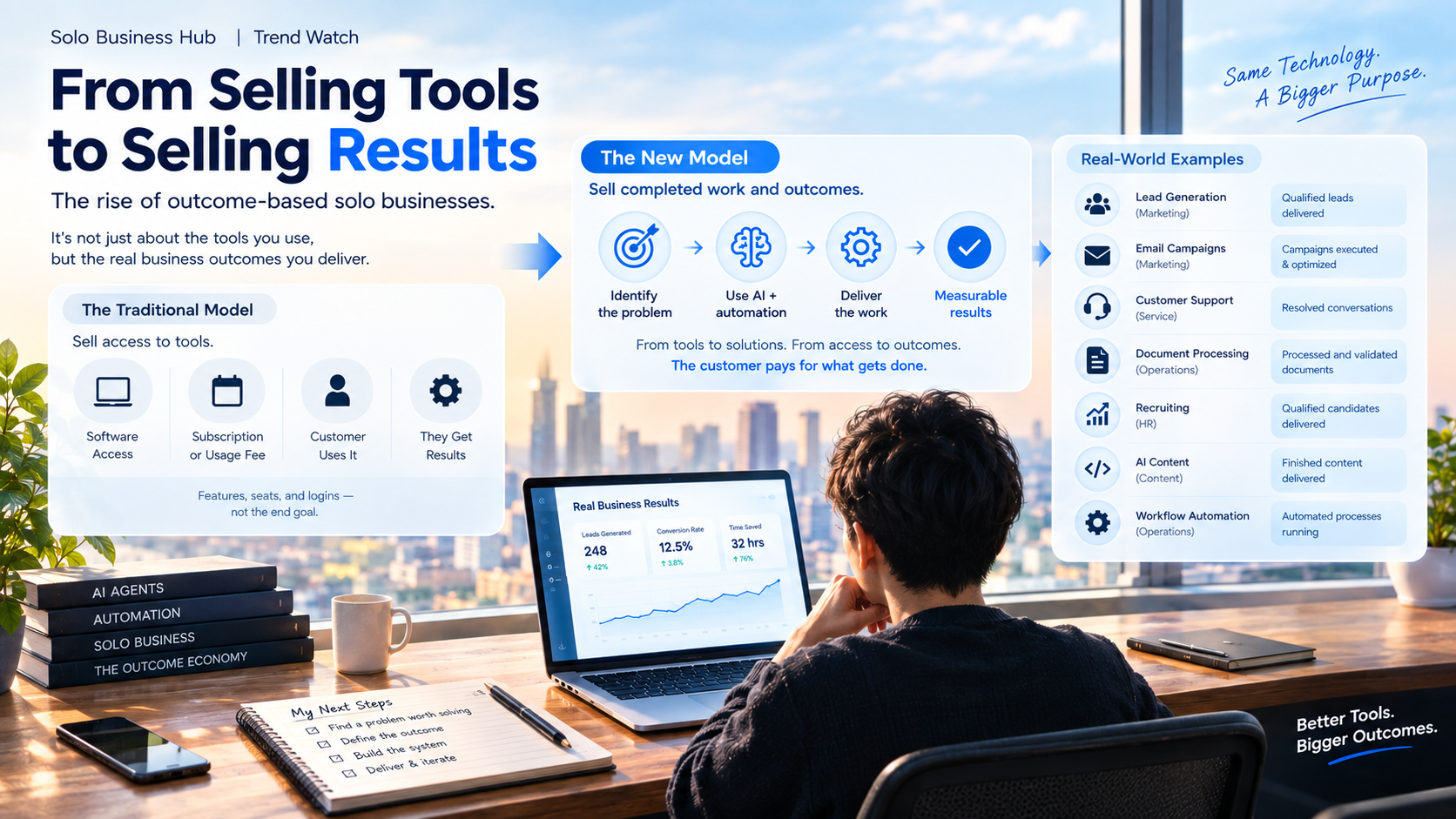
Instead of selling software access, businesses can sell completed work.
Instead of selling an automation platform, they can sell an automated process.
Instead of selling an AI agent, they can sell the outcome produced by that agent.
This shift is especially relevant for solo entrepreneurs.
A one-person business does not need to compete with a large software company feature for feature. It can instead identify one expensive, repetitive or difficult business problem and build a system that solves it—using AI, automation, APIs and human oversight behind the scenes.
The emerging model can be summarized simply:
> Don't sell the tool. Sell what the tool accomplishes.
This is not merely a pricing change. It represents a potential change in how a solo business is designed, delivered and monetized.
The Shift: From Software Access to Business Outcomes
Traditional software generally asks customers to pay for access.
Familiar models include:
- Per user / per seat
- Per month
- Per feature
- Per API call or usage unit
The newer model reverses that relationship. The provider takes more responsibility for producing the outcome, while the customer pays according to an agreed measure of completed work.
| Traditional model | Outcome-oriented model |
|---|---|
| CRM subscription | Qualified leads delivered |
| Email software | Campaigns executed and optimized |
| Customer-support software | Support conversations resolved |
| Recruiting software | Qualified candidates delivered |
| Data-processing software | Documents successfully processed |
| AI writing tool | Finished content delivered |
| Automation platform | Business workflow operated |
This distinction becomes far more practical when AI agents are involved.
Why AI Makes This Shift More Practical
Traditional software generally required a human operator. A CRM could organize leads, but someone still had to manage them. A support platform provided a dashboard, but employees still answered customers. An automation platform connected applications, but someone had to design and maintain the workflow.
AI agents introduce another possibility. An agent can potentially:
- Understand a goal
- Inspect relevant information
- Decide required actions
- Use connected tools
- Execute multiple steps
- Evaluate the result
- Escalate exceptions to a human
This is already visible in commercial AI products.
In April 2026, HubSpot announced that its Breeze Customer Agent and Breeze Prospecting Agent would move to outcome-based pricing: $0.50 per resolved conversation for the Customer Agent, and $1 per lead recommended for outreach for the Prospecting Agent.
Intercom’s Fin AI Agent uses a similar approach, charging primarily $0.99 per defined outcome (such as resolutions and certain procedure handoffs), with higher rates for specific high-value outcomes like successful qualifications in some sales contexts.
These examples matter because they show major software companies experimenting with charging for what AI accomplishes rather than simply for access to AI.
Outcome-Based Pricing Is Becoming a Recognized Software Model
This is not limited to a few AI startups.
Surveys of enterprise software decision-makers (including Futurum Group’s 2026 research) indicate growing experimentation with outcome-based pricing for AI features, while pure consumption-based preferences have softened in some categories. Seat-based and consumption models remain important, especially at the platform layer, but the direction is clear.
AWS now documents outcome-based pricing as part of its guidance on the economics of agentic AI, describing models in which payment is tied to standardized, measurable successful outcomes. Deloitte has published accounting guidance specifically addressing outcome-based pricing in agentic AI software arrangements.
The important point is not that outcome pricing will become universal.
The important point is that the unit of value is becoming more negotiable.
What This Means for a One-Person Business
A traditional solo founder might think:
> “What software can I build?”
An outcome-oriented founder asks:
> “What business result can I reliably deliver?”
Tool-first thinking
Idea ↁEBuild software ↁEFind users ↁEConvince them to subscribe ↁESupport users ↁEAdd featuresOutcome-first thinking
Business problem ↁEDefine measurable outcome ↁEDesign delivery process ↁEUse AI + automation + software ↁEDeliver result ↁEStandardize ↁECharge for valueThe second approach is particularly attractive to an OPC because it does not require building a large software company before revenue begins. A solo founder can start with a service, standardize it, automate parts of delivery, and gradually productize the workflow.
The New Solo Business Stack
The boundary between service business and software business is becoming less clear.
A solo founder serving independent law firms might begin with an “AI Legal Intake Setup Eservice (automation, classification, document collection, CRM updates). After several clients, 80% of the workflow proves identical. The offer evolves into a productized service, then a managed service, and eventually vertical software.
Consulting ↁEProductized Service ↁEAI Implementation ↁEManaged AI Service ↁEVertical AI ProductThe founder does not have to choose between “service Eand “software Eon day one. The business can move between them as the workflow becomes understood.
AI Implementation and the FDE Lens
A new category of solo business is emerging: AI Implementation.
Customers often do not want another AI tool. They want someone to answer:
> “How do I actually make this work inside my business?”
The solo operator analyzes the workflow, selects tools, connects systems, builds agents, sets guardrails and monitors performance. The deliverable becomes “Automate your inbound lead qualification Erather than “We provide an AI agent platform.”
The emerging Forward Deployed Engineer (FDE) model offers a useful parallel: working close to customers to adapt technology to real operational problems. Combined with AI leverage, this creates a powerful pattern for an OPC:
> OPC + FDE-style delivery + AI
The result is a one-person business that enters a customer’s workflow, solves a defined problem, and continues operating or improving the system—fundamentally different from selling hours as a conventional freelancer.
From Hourly Billing to Value Units
Traditional consulting often charges by the hour. An outcome-oriented provider might charge per qualified appointment, per resolved case, or per processed document batch.
Outcome pricing works better when:
- The outcome is clearly defined
- The provider controls most of the delivery process
- Success can be measured objectively
- The customer recognizes the economic value
- Exceptions can be handled systematically
The Hardest Part: Defining the Outcome
Vague promises fail. “We will improve your sales Eis not precise enough.
Better definitions include:
- “We will identify and qualify inbound leads according to the agreed criteria.”
- “We will resolve eligible customer-support conversations without human intervention.”
- “We will process documents that meet the agreed input requirements.”
Why This Matters Especially for OPCs
A large software company often needs millions of customers. An OPC does not. A solo operator can build around 10 clients at $2,000/month rather than 10,000 users at $20/month.
Focus on a narrow, high-value problem:
| Weak positioning | Stronger positioning |
|---|---|
| AI Marketing | Qualified leads for local law firms |
| AI Content | 20 SEO-ready product pages per month |
| AI Automation | Automated inbound lead qualification |
| AI Research | Weekly competitor intelligence |
| AI Customer Support | Resolved first-line support cases |
| AI Recruiting | Qualified candidate shortlist |
| AI Data Processing | Processed and validated documents |
The Productized-Service Bridge
A productized service has a defined customer, problem, scope, process, price and deliverable. AI can then automate portions of delivery. Standardization creates leverage; excessive customization destroys it.
The spectrum of delivery models includes:
- DIY ECustomer operates the software
- Done With You EProvider helps configure
- Done For You EProvider performs the work
- Managed Outcome EProvider continuously operates the system and is accountable for defined results
Major Limitations
The “sell results Enarrative can easily become hype. Key structural challenges remain:
- Not every outcome is measurable EDesign quality, strategy and creative work often resist single metrics.
- The provider does not control everything ELead generation cannot guarantee closed deals if product or sales execution is weak.
- Outcomes still cost money EInference, APIs, data, integrations and human review remain real costs.
- Verification is essential EBoth parties must agree on what counts as success.
- AI reliability is still uneven EAgents can fail, misunderstand context or encounter unexpected states. Human oversight remains critical for consequential processes.
> Use AI to make a clearly defined business result economically deliverable by a very small team.
Three Emerging Solo Business Models
1. Outcome-Based Service EPerform the work using AI behind the scenes (e.g., $100 per qualified lead).
- Managed AI System EInstall and operate the workflow (e.g., setup fee + monthly retainer).
- Vertical AI Product ETurn the repeated workflow into software.
Service ↁELearn the workflow ↁEStandardize ↁEAutomate ↁEProductize ↁESoftwareWhat Solo Founders Should Sell
The strongest formula remains:
> Specific Customer + Expensive Problem + Measurable Outcome + Repeatable Process
Competitive advantage increasingly comes from domain knowledge, workflow understanding, proprietary context, distribution, trust and measurement—rather than from the underlying model itself.
The model is becoming a commodity.
The workflow becomes the product.
The outcome becomes the value proposition.
Bottom Line
The biggest opportunity may not be to build the next AI tool.
It may be to build a business where the customer never needs to care which tool you use.
They care about one thing:
> Did the job get done?
For a solo founder, that shift—from selling tools to selling results—could prove more important than any individual AI model or application.
• The tool is becoming the infrastructure.
The workflow is becoming the product.
The outcome is becoming the value.