On June 1, 2026, during NVIDIA’s GTC Taipei keynote ahead of Computex, CEO Jensen Huang unveiled the RTX Spark superchip, a groundbreaking innovation that promises to fundamentally transform personal computers. Huang described it as the biggest reinvention of the PC in 40 years—comparable to the shift from feature phones to smartphones. This new platform shifts computers from passive tools to proactive intelligent partners, ushering in the era of Agentic AI Personal Computers.
RTX Spark: The Heart of Next-Generation AI PCs
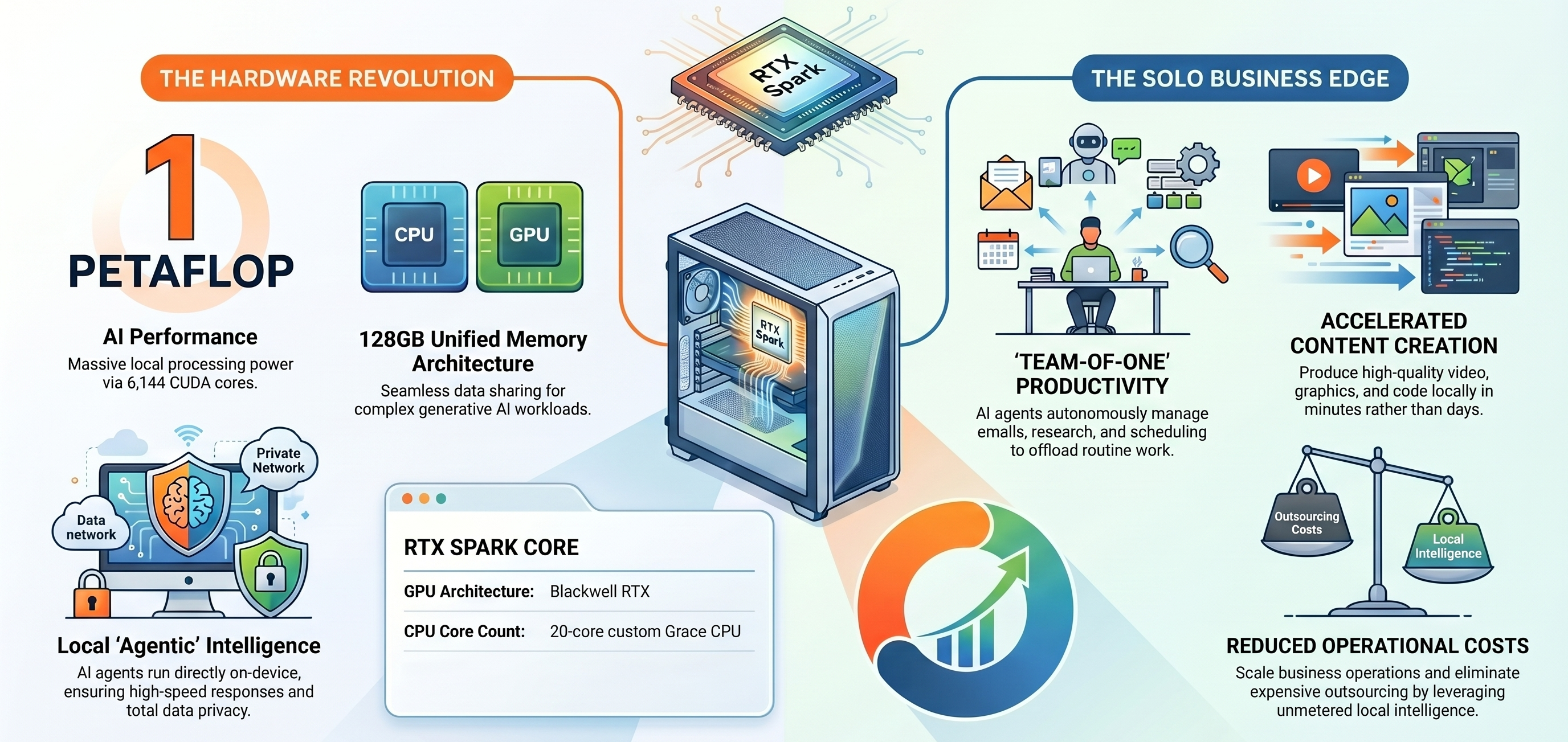
The RTX Spark is a powerful “superchip Edeveloped in collaboration with MediaTek and manufactured on TSMC’s advanced process. It tightly integrates a Blackwell RTX GPU (with 6,144 CUDA cores) and a custom 20-core Grace CPU, delivering up to 1 petaflop of FP4 AI performance and supporting up to 128GB of unified memory.
Key features include:
- Local Agentic AI Capabilities: Run large AI models and autonomous agents directly on the device without constant cloud dependency. Agents can handle complex, multi-step tasks such as research, content generation, file management, photo/video editing, and workflow orchestration.
- Unified Memory Architecture: Enables seamless data sharing between CPU, GPU, and AI accelerators for superior efficiency in generative AI, creative workloads, and gaming.
- Full Ecosystem Support: Complete CUDA and RTX compatibility, deep Windows integration with Microsoft, and optimized applications from partners like Adobe (rebuilding Photoshop and Premiere Pro for this architecture).
- Versatile Performance: Excels in high-frame-rate gaming (with DLSS and ray tracing), professional content creation, AI development, and everyday productivity—all in slim laptops and compact desktops.
Core Characteristics of Computers in the AI Age: From Tools to Teammates
Traditional PCs required users to launch apps, click, and type. In the AI era, you ask—and the PC acts. RTX Spark embodies this shift through:
- On-Device Intelligence and Privacy: AI processing happens locally for faster responses and better data security—critical for sensitive work.
- Agentic AI: Autonomous agents that understand context, plan tasks, collaborate across applications, and execute on your behalf via voice or natural language.
- Accelerated Creativity and Productivity: Real-time generation, editing, and inference for images, video, code, and more, powered by GPU parallelism and dedicated AI engines.
- Hybrid Intelligence: Complements cloud AI for massive models while delivering “unmetered intelligence Eon your primary device.
Profound Impact on Solo Businesses (Solopreneurs and One-Person Enterprises)
For Solo Business owners—freelancers, independent creators, consultants, coaches, and one-person startups—this technology could be truly transformative, acting as a force multiplier that lets one individual operate like a small team.
- Team-Level Productivity on Your Own: AI agents can autonomously manage emails, generate reports, conduct market research, create social media content, handle basic financial tasks, or even draft proposals. Routine work is offloaded, freeing you to focus on high-value client relationships and strategic decisions.
- Accelerated Content and Marketing: Produce high-quality blog posts, videos, graphics, and campaigns in minutes rather than hours or days. Local AI ensures consistent branding without relying on expensive freelancers or slow cloud services.
- Enhanced Privacy and Security: Keep client data, business strategies, and proprietary information processed securely on-device—vital for consultants, legal professionals, or anyone handling confidential projects.
- Cost Efficiency and Scalability: Reduce outsourcing and subscription costs while scaling operations. Many solopreneurs are already using AI to grow revenue without hiring; RTX Spark makes this even more powerful and accessible.
- Faster Iteration and Innovation: Developers and product builders can fine-tune models, test ideas, and prototype locally with minimal latency and expense.
Purchasing Advice for Solo Business Owners
If you run a Solo Business, now is the time to evaluate upgrading to an RTX Spark-powered machine when they launch this fall. Here are practical recommendations:
• Prioritize RTX Spark Devices
Look for slim, portable laptops for on-the-go work or compact desktops for heavy workloads. Strong initial options are expected from HP, Dell, Lenovo, ASUS, and Microsoft Surface lines.
• Key Specs to Target
- At least 64GB unified memory (128GB ideal for demanding AI agents and large models).
- Excellent battery life and thermal performance for all-day AI tasks.
- Strong display and I/O for creative and multitasking needs.
• Budget Tiers
- Entry-Level: Mid-range models for general productivity and lighter agent use.
- Recommended for Most Solopreneurs: Premium laptops paired with an external monitor or docking station—balancing portability with power.
- Power Users (video editors, 3D creators, model trainers): Consider mini-desktop configurations as your workstation core.
• Timing and Ecosystem
Buy shortly after launch to access mature software optimizations. Verify Adobe, Microsoft Copilot, and NVIDIA tool support for your workflow.
• Hybrid Strategy
Use the AI PC for fast, private, everyday tasks and retain cloud services for ultra-large models. Invest time in prompt engineering and agent orchestration skills to maximize ROI.
Conclusion
Jensen Huang’s RTX Spark is more than a new chip or computer—it is a declaration of the AI-native personal computing era. For Solo Business operators, it represents an intelligent partner that amplifies human potential, reduces operational friction, and unlocks new levels of independence and creativity. As these devices roll out this autumn, early adopters stand to gain a significant edge. The future of work is agentic, local, and profoundly personal—RTX Spark makes it tangible today.
(This article is compiled based on Jensen Huang’s GTC Taipei 2026 keynote and related official announcements.)