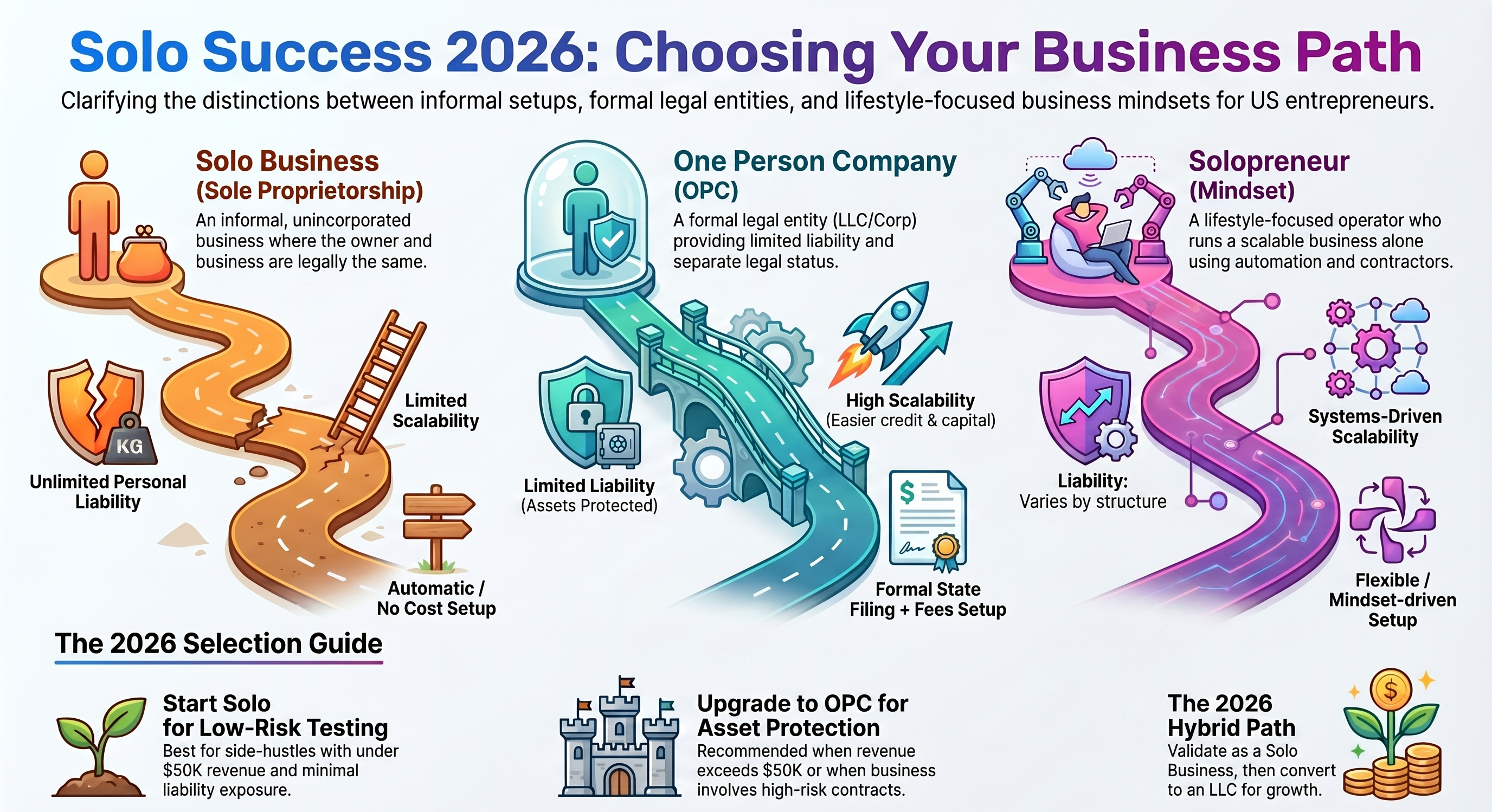
One Person Company (OPC) vs Solo Business vs Solopreneur: Differences, Pros & Cons, and 2026 US Selection GuideA practical US-focused 2026 guide to legal structure, liability, taxes, credibility, and the best path for lean solo founders.

In the United States, solo founders often use One Person Company (OPC), Solo Business, and Solopreneur as if they mean the same thing. They do not.

A One Person Company usually points to a formal legal structure, most commonly a Single-Member LLC or a single-owner corporation. A Solo Businessusually means an informal sole proprietorship. A Solopreneur is not a legal entity at all. It describes a mindset and operating style built around independence, lean systems, personal leverage, and minimal headcount.

Whether you are searching for One Person Company USA, OPC vs Solo Business, or Solopreneur vs Sole Proprietorship, this 2026 guide explains the differences and helps you choose the best path.

Choosing your 2026 business path between one person company, solo business, and solopreneur

Key Differences

AspectSolo Business
Usually a sole proprietorship
One Person Company
Single-Member LLC or similar entity
Solopreneur
Mindset plus operating style
DefinitionInformal, unincorporated business run by one personFormal legal entity owned and operated by one personA solo operator who builds a business alone, regardless of legal structure
Legal StatusNot a separate entity; you and the business are the sameSeparate legal entity with limited liabilityCan use any legal structure
LiabilityUnlimited personal liabilityLimited liability; personal assets generally protectedDepends on the chosen legal structure
Setup ComplexityAutomatic once you start operatingRequires filing, fees, and formal setupFlexible; follows the legal structure selected
TaxesPass-through taxation with full self-employment taxPass-through by default; can add S-Corp election for optimizationSame as the legal structure used
CredibilityUsually lowerUsually higher for contracts, clients, and banksBuilt through brand, reputation, and results
ScalabilityMore limitedHigher; easier to add team, partners, or financing laterHigh through systems, automation, and contractors
Best ForLow-risk testing and simple freelance workSerious growth with legal protectionLifestyle-focused independence and lean operations
ComplianceMinimalModerate; annual reports, separation, and entity upkeepVaries by entity

Pros And Cons

Solo Business

Usually a sole proprietorship

Pros
  • Quickest and cheapest to start
  • Simple tax filing with Schedule C
  • Full control with minimal paperwork
  • Strong fit for side hustles and low-risk services
Cons
  • Unlimited personal liability
  • Harder to build business credit
  • Less professional image for larger clients
  • Full self-employment taxes on all profit

One Person Company

Typically a Single-Member LLC or single-owner corporation in the US

Pros
  • Limited liability protection is the main advantage
  • Higher credibility with banks, clients, and partners
  • More tax flexibility, including S-Corp election potential
  • Better path for financing, contracts, and long-term planning
Cons
  • Higher upfront and ongoing costs
  • More administrative work and recordkeeping
  • Must maintain clear legal separation
  • Accounting and compliance can cost more

Solopreneur

A mindset and operating style, not a legal entity

Pros
  • Maximum freedom, autonomy, and location flexibility
  • Strong fit for personal brand businesses
  • Can scale with automation and contractors instead of employees
  • Works with either a sole proprietorship or LLC structure
Cons
  • Burnout risk if systems are weak
  • Income may depend heavily on your direct presence
  • Personal and business identity can blur together
  • Scaling is limited without delegation or automation

2026 Selection Guide

Choose a Solo Business If

  • You are testing an idea or running a low-risk side hustle
  • Revenue is modest and liability exposure is low
  • You want maximum simplicity and minimum cost
  • You are not ready to invest in formal entity setup yet

Choose a One Person Company If

  • You want to protect valuable personal assets
  • Your work involves contracts, products, client data, or higher legal risk
  • Revenue is growing toward roughly $50K to $100K or more
  • You want more credibility, financing options, and long-term scalability

Adopt the Solopreneur Path If

  • You care deeply about freedom, independence, and lifestyle design
  • You are willing to be the face of the brand
  • You want to stay lean while outsourcing non-core work
  • You plan to combine solo operation with systems, AI, and contractors
Popular Hybrid Path

Start as a solopreneur running a solo business to validate the idea quickly. Once revenue grows and risk increases, convert to a One Person Company, most often a Single-Member LLC, while keeping the same lean solopreneur operating style. Many founders then add an S-Corp election for tax optimization.

Additional Considerations

  • State choice still matters. Delaware, Wyoming, and Nevada remain popular for business-friendly formation and privacy features.
  • Insurance still matters. Liability protection from an entity does not replace the need for proper insurance coverage.
  • Lean tools matter. Solopreneurs often rely on tools like Zapier, Notion, AI platforms, and contractor marketplaces to stay efficient.
  • International founders can often form a US LLC to serve American customers, but tax and compliance details vary.

Next Steps

  1. 1Assess your risk level, revenue goals, and lifestyle priorities
  2. 2Research your state formation requirements and costs
  3. 3Obtain a free EIN from the IRS if needed
  4. 4Open a dedicated business bank account
  5. 5Prepare core agreements for clients and contractors
  6. 6Consult a CPA or business attorney for tailored advice
  7. 7Register for required licenses and sales tax permits

Bottom Line For 2026

A Solo Business offers the simplest entry point. A One Person Companydelivers legal protection, professionalism, and better scaling options. The Solopreneurpath describes how you operate: lean, independent, system-driven, and freedom-focused.

In practice, many successful solo founders combine a One Person Company structure with a Solopreneur operating style to get the best balance of protection, flexibility, and long-term growth.

This is general educational information, not legal or tax advice. Laws, filing rules, and tax treatment vary by state and personal situation. Consult qualified professionals for your specific case.

Quick FAQ

Is a one person company the same as a solopreneur?

No. A one person company usually refers to a legal structure such as a Single-Member LLC or single-owner corporation, while a solopreneur describes an operating style and mindset.

Is a solo business usually a sole proprietorship in the US?

Yes. In most cases, a solo business means an informal sole proprietorship owned and run by one person without a separate legal entity.

Which option gives the best liability protection?

A formal one person company structure such as a Single-Member LLC generally offers much better liability protection than a sole proprietorship, assuming it is maintained properly.

Can I be a solopreneur and still form an LLC?

Yes. Many solopreneurs use a Single-Member LLC because it combines solo operation with stronger legal protection and better business credibility.

What is the most common hybrid path for solo founders in 2026?

Many founders start as solopreneurs using a simple solo business structure to validate demand, then convert to a Single-Member LLC and sometimes elect S-Corp taxation once revenue and risk increase.

Share the Joy and Fun!
Spread the word to your friends and community.