On June 9, 2026, Anthropic launched Claude Fable 5 - its first Mythos-class model made safe and available for general public use.
This was not a routine upgrade.
It marked a real leap into the long-horizon Agent era, where AI can autonomously handle complex, multi-day projects with minimal intervention.
For solopreneurs and one-person companies, Fable 5 offered a glimpse of what a true "super employee" looks like: the ability to plan, execute, self-correct, and deliver end-to-end results on ambitious work.
Even though access was temporarily suspended days later because of U.S. government export control directives affecting foreign nationals, the model's brief availability and underlying capabilities already changed expectations for solo businesses in 2026.
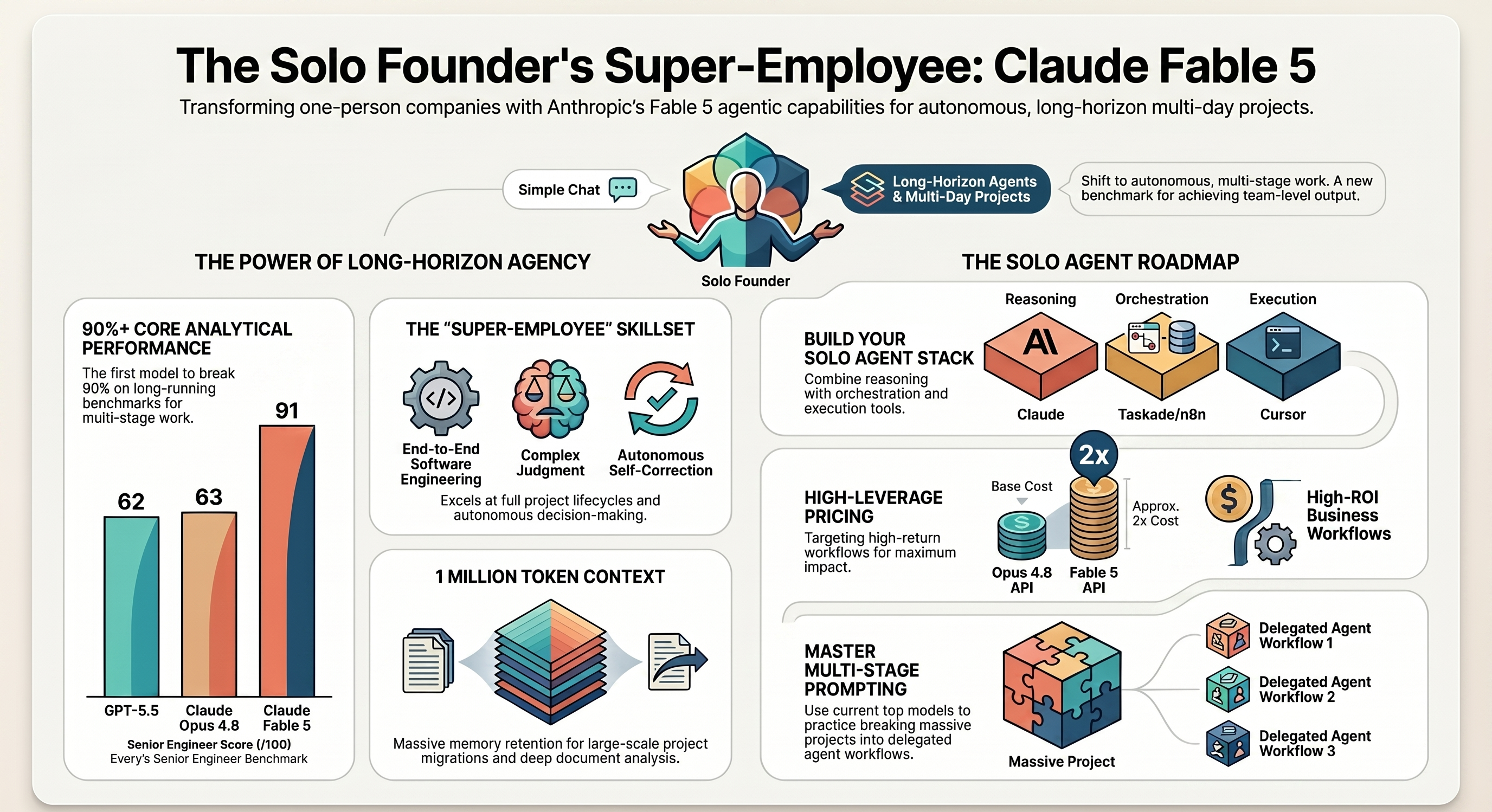
Why Fable 5 Was Such a Big Deal
Most AI upgrades are incremental.
Fable 5 felt different because it appeared to break through one of the biggest bottlenecks in practical AI use: sustained performance on messy, multi-step, long-duration work.
For solo founders, that is exactly where leverage matters most.
It is relatively easy to get AI to generate a paragraph, rewrite an email, or produce a shallow list.
It is much harder to get AI to:
- maintain direction over many hours
- keep context across many files and decisions
- push back on weak assumptions
- self-correct when the first answer is wrong
- finish an end-to-end project without constant babysitting
Fable 5's Standout Capabilities
- Long-Horizon Agentic Performance - The first model to break 90% on core long-running analytical task benchmarks, representing a 10+ point jump over previous Claude generations.
- State-of-the-Art Across Domains - Extremely strong benchmark performance across software engineering, knowledge work, scientific reasoning, vision, and complex judgment.
- Superior Coding and Project Building - Better at large code migrations, architecture choices, debugging, and full project delivery with fewer hallucinations on extended tasks.
- Context and Memory - Up to 1 million tokens of context, stronger retention across long sessions, and improved self-correction loops.
- Multimodal Strength - Better vision, document analysis, and tool use for real-world business workflows.
What This Means for One-Person Companies
The traditional limits of solo work are not just about labor.
They are about sustained cognition.
A solo founder usually hits a wall on:
- time
- complexity
- research depth
- technical execution
- decision fatigue
Product Development
A vague idea could be turned into a production-ready feature spec, prototype plan, implementation roadmap, and supporting launch materials in days instead of weeks.
For solo SaaS builders, this means faster shipping, less context loss, and better follow-through on larger product initiatives.
Deep Research and Strategy
Fable 5 was especially compelling for projects that require synthesis:
- multi-source market research
- competitor teardowns
- pricing analysis
- positioning strategy
- go-to-market planning
- sales materials
Complex Operations
One-person companies often avoid sophisticated operational systems because they seem too time-consuming to design and maintain.
Long-horizon agentic models change that equation.
Potential workflows include:
- data reconciliation
- financial modeling
- legal document review
- large-scale content operations
- process documentation
- cross-tool workflow coordination
Code and Technical Work
This is where many solo developers noticed the gap most clearly.
Reports highlighted stronger performance on:
- multi-file implementations
- major refactors
- architecture decisions
- debugging deep issues
- rejecting flawed directions instead of passively agreeing
Why the Gap Matters More for Solopreneurs Than Teams
Large teams can hide inefficiency with headcount.
One-person companies cannot.
A solopreneur needs tools that reduce:
- switching costs
- iteration time
- planning overhead
- rework
- cognitive fragmentation
The difference between "good at short tasks" and "excellent at long, high-stakes work" is the difference between an assistant and an actual force multiplier.
Pricing and Access Reality at Launch
- Initially available on Pro, Max, Team, and Enterprise plans at no extra cost until June 22, 2026.
- API pricing launched at $10 per million input tokens and $50 per million output tokens.
- That pricing placed it at roughly 2x Opus 4.8, making it better suited for high-value, high-leverage tasks where better quality saves large amounts of founder time.
If a stronger model saves multiple rounds of revisions, prevents strategic mistakes, or compresses a week of work into a day, the ROI can still be excellent.
The Regulatory Pause Did Not Kill the Signal
Shortly after launch, Anthropic paused access because of export control directives and compliance concerns.
That pause matters operationally, but it does not erase what the launch revealed.
The message is clear:
frontier agent capabilities are here, progress is accelerating, and solopreneurs should treat long-horizon AI as an approaching operating layer - not a distant concept.
Anthropic is working through compliance and restoration paths, while rival labs continue racing toward the same destination.
Act Now: Prepare for the Next Wave
Even without full Fable 5 access today, solo founders can act immediately.
1. Upgrade Your Claude Plan
If you rely on Anthropic's ecosystem, moving to Pro or above gives you a better position when expanded availability returns.
2. Master Current Frontier Models
Use current high-end models such as Claude Opus 4.x, GPT-5.x, or Gemini 3.1 Pro to practice agent-style work:
- break big projects into multi-stage workflows
- use Projects, Artifacts, and tools
- manage longer feedback loops
- keep outputs structured and reusable
3. Build Your Solo Agent Stack
A practical stack today could look like:
- Core reasoning: Claude or GPT
- Orchestration: Taskade, n8n, or Zapier Agents
- Research: Perplexity
- Execution: Cursor for coding, OpenClaw or Accio for operations
4. Test Long-Horizon Projects Right Now
Do not wait for the perfect model.
Start assigning a real business task such as:
- build a full feature specification
- draft a prototype plan
- generate a marketing outline
- synthesize market research into positioning
Final Takeaway for Solo Founders
Fable 5's short appearance was like a flash of lightning.
It illuminated the near future of one-person companies powered by mythic-level intelligence.
It suggested that solo founders will soon be able to tackle projects once reserved for small teams - with higher quality, more continuity, and dramatically lower overhead.
• Do not wait for perfect access.
Start rebuilding your operating system now with the best models available today.
Delegate repetition.
Delegate complexity.
Reclaim your time for strategy, creativity, and customer relationships.
That is how one-person companies become formidable in 2026 and beyond.
Quick FAQ
• What made Fable 5 different from earlier Claude models?
Its biggest distinction was long-horizon performance: stronger planning, better retention, improved self-correction, and far more reliable execution on multi-stage work.
• Why did solopreneurs care so much about the launch?
Because one-person companies need leverage on long, messy, high-value tasks, not just quick content generation.
• Was Fable 5 widely available?
It was initially made available through several Anthropic plans, but access was paused shortly after launch because of export control and compliance directives.
• Should founders wait until Fable 5 returns?
No. The better move is to build agent-native workflows now with the best currently available models and be ready to upgrade as stronger systems return.
• Where can I prepare for future access?
Visit [claude.ai](https://claude.ai) and Anthropic's official channels to follow plan updates and access changes.
The Agent era rewards founders who act earliest.
Prepare Your Agent-Native Workflow Before Access Expands Again
The biggest opportunity is not waiting for one specific model. It is learning how to structure longer projects, review multi-stage outputs, and build systems that let AI handle real business execution.